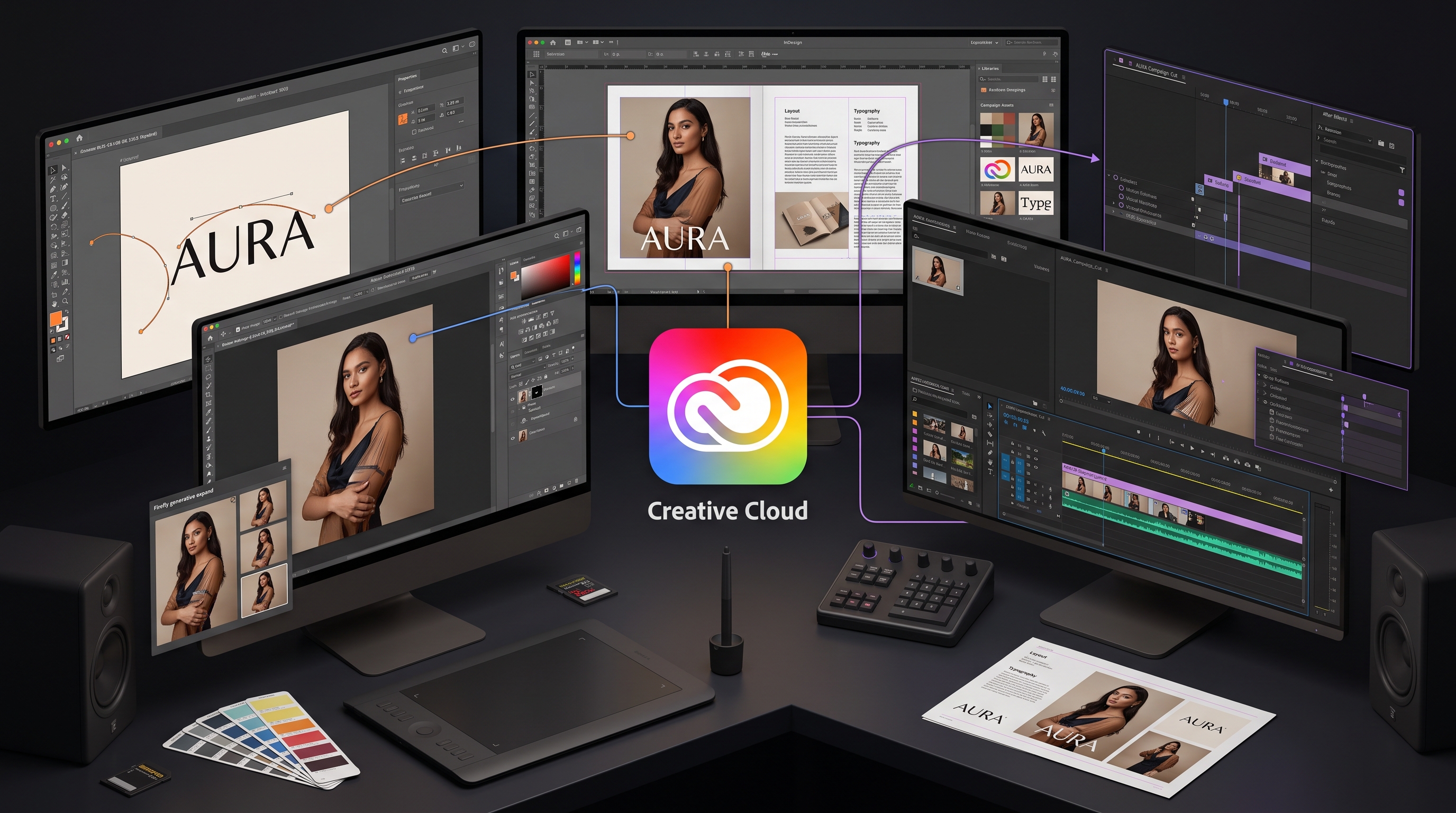
Adobe Creative Cloud is still the broadest mainstream subscription for professional design, photography, illustration, video, motion, layout, and related creative work. Its main advantage is not that every app is perfect. It is that a working creator can move between mature tools, shared assets, cloud documents, fonts, templates, and familiar file formats without rebuilding a workflow around separate vendors. The trade-off is a high recurring cost, a large desktop footprint, and plan rules that are easy to underestimate.
This review is research-based. We checked Adobe’s public pricing, product, help, security, privacy, legal, and compatibility material on August 23, 2026. We did not use a paid Adobe account or claim first-hand workflow results.
Product profile
Adobe Creative Cloud
Inspect the structured Adobe Creative Cloud profile for the current site score, plan snapshot, platform list, and product-level facts.
Quick verdict
Adobe Creative Cloud is recommended with caveats for professional freelancers, creators, and small agencies that use multiple creative disciplines. Choose it when Photoshop, Illustrator, Premiere, InDesign, After Effects, cloud documents, Libraries, and Adobe handoffs are part of real monthly work. Avoid the full suite when you only need one app, make occasional social graphics, or need a subscription you can leave without an annual-plan penalty. The best next step is to list the apps you will use every month, price the equivalent Single App or Pro plan, and read the cancellation terms before starting a trial.
What Adobe Creative Cloud is
Creative Cloud is a subscription family rather than one application. The individual Pro plan includes more than 20 creative apps, including Photoshop, Illustrator, Premiere, Acrobat Pro, After Effects, InDesign, Lightroom, Audition, Animate, Dreamweaver, Adobe Express, and Firefly-related services. The exact app mix, web and mobile access, AI allowance, cloud storage, and business controls depend on the plan. Adobe also sells Single App, Standard, student, team, and enterprise options.
That distinction matters when comparing Adobe with a simpler tool. You are buying access to a connected family of professional applications, but you are also accepting several installers, separate interfaces, version updates, system requirements, and a learning curve that varies by app. Creative Cloud is best understood as infrastructure for a creative practice, not as a lightweight design editor.
Who Creative Cloud is designed for
The strongest fit is a creator whose work crosses formats. A freelance brand designer may need Illustrator for vectors, Photoshop for images, InDesign for documents, and Acrobat for client review. A video creator may add Premiere, After Effects, Audition, Photoshop, and Frame.io for Creative Cloud. A small agency may value team licensing, shared Libraries, version history, and the ability to reassign assets when people change roles.
The suite is less compelling when your work is narrow. A photographer who only needs photo editing should compare the Photography plan or Lightroom first. A social media manager who makes occasional posts may need Adobe Express or a browser-first tool. A team that mostly comments on files should not automatically buy a full creative seat for every reviewer.
Main features and why they matter
Professional apps across one subscription
Photoshop, Illustrator, Premiere, InDesign, After Effects, Lightroom, and Acrobat each cover a different production problem. The practical benefit is compatibility. A logo can move from Illustrator into a layout or video project, a photo can be prepared in Photoshop and edited in Lightroom, and a client can receive a PDF or review link without another export system. This replaces some separate subscriptions, but only if you use enough of the included apps to justify the whole plan.
Firefly and generative credits
Adobe now separates standard and premium generative features. Creative Cloud Standard lists 25 monthly generative credits, while Creative Cloud Pro lists 4,000 monthly credits for premium generations and unlimited access to standard generations. Adobe’s help material says premium credit use varies with the model, output, and file size. That makes the credit number useful as a budget signal, not a fixed number of finished images or videos. Heavy video and audio generation can push buyers toward a separate Firefly plan or add-on.
Cloud documents, Libraries, and handoffs
Cloud documents can be opened offline, sync changes when you reconnect, and create versions as you work. Creative Cloud Libraries let teams share colors, graphics, fonts, and other design assets with view or edit permissions. These features matter when several people need the same brand source of truth. They do not turn every project into a frictionless shared workspace. Storage limits, file ownership, permissions, and the difference between a cloud document and a Library asset still need attention.
How it works in practice
Adobe’s normal setup starts in Adobe Home or the Creative Cloud desktop app. You select an app, install it, and use the desktop manager to update it, view product details, manage plugins, or uninstall it. Web-based apps can open in a browser without installation. Cloud documents can be saved from supported apps, shared for review, and used offline after they have been opened. Cross-app handoffs are the main reason to accept the suite’s size. A project can move from photo editing to layout to video without asking every contributor to learn a new vendor’s export rules.
There are practical limits. Adobe supports current operating systems aggressively, and the current compatibility page says desktop apps generally support the latest two previous major operating-system versions, while web and mobile apps are limited to the latest operating-system version. Video apps have narrower OS support. The suite also needs enough local storage, RAM, graphics performance, and time for updates. These are normal professional-tool costs, but they should be part of a buying decision.
Ease of use and setup
The Creative Cloud desktop app gives beginners one place to find and install many tools. Adobe’s public help material also provides tutorials, troubleshooting, community answers, and app-specific guidance. That reduces the first setup problem. It does not remove the second problem, which is learning which tool belongs to which task. Photoshop, Illustrator, Premiere, InDesign, and After Effects use different concepts and resource requirements. A solo creator can learn this over time. A small agency should assign someone to manage app versions, templates, Libraries, and permissions.
Pricing and plans
The prices below are current US prices checked on August 23, 2026. Adobe shows many individual plans as annual subscriptions billed monthly. Taxes are not included. Adobe’s page may also show promotions for new subscribers, so use the recurring list price, not the introductory price, when comparing long-term cost.
Current individual Creative Cloud plans checked August 23, 2026| Plan | Price and billing | Main use | Important limit or upgrade trigger |
| Single App | US$22.99/mo, annual billed monthly; about US$275.88/year | One desktop app, 100GB storage, Adobe Fonts, 25 monthly generative credits | Upgrade when two or more Adobe apps become regular tools; annual cancellation terms still apply |
| Creative Cloud Standard | US$54.99/mo, annual billed monthly; about US$659.88/year | 20+ desktop apps, 100GB storage, 25 monthly credits | Web, mobile, and iPad access is more limited than Pro; heavy AI use needs more capacity |
| Creative Cloud Pro | US$69.99/mo, annual billed monthly; about US$839.88/year | 20+ apps, full web/mobile/iPad access, 4,000 premium credits, unlimited standard generations | The extra US$15/mo is hard to justify if you do not need broader access or regular AI generation |
| Creative Cloud Pro for teams | US$99.99 per license/mo, annual billed monthly; about US$1,199.88 per license/year | Full suite plus business license management, shared assets, and advanced support | Buy for active creators, not every reviewer; enterprise needs custom sales and procurement |
Adobe states that most plans have a full-refund window within the first 14 days. For an annual plan paid monthly, cancelling after 14 days can trigger a fee equal to 50% of the remaining contract balance. This is the most important pricing condition to understand before choosing the lower monthly payment.
Free plan and free trial
The full Creative Cloud suite does not have an ongoing free plan. Adobe offers seven-day free trials for individual Creative Cloud apps and asks for payment details during sign-up. If you cancel during the trial, Adobe says you can cancel online without a fee. That is enough time to check whether the app opens on your computer, but it is not enough time to learn a full professional workflow. After a paid membership ends, Adobe says the account can move to a free membership with 5GB of cloud storage. If your cloud files exceed that limit, you have 30 days to move them before losing access to some or all server-stored files.
Important limits and upgrade triggers
- The cheaper Standard plan does not give the same full web, mobile, and iPad access as Pro. Check the exact app feature matrix if you work away from a desktop.
- AI credits are monthly and premium generations can use different amounts. A creator producing video or audio should treat Firefly as a separate usage budget.
- Annual billed monthly is still an annual commitment. A lower monthly figure does not mean a month-to-month contract.
- Cloud storage is part of the workflow, but cancellation changes the quota to a free-membership limit. Keep local copies and an export plan for important client work.
- Creative Cloud apps need compatible operating systems and hardware. Video workflows have narrower support than a basic image editor.
- Business and enterprise controls are not interchangeable with an individual plan. Teams should buy the plan that matches their ownership, administration, and procurement needs.
Integrations and compatibility
Creative Cloud’s most useful integrations are Adobe-to-Adobe. Premiere can import still images or image sequences from Photoshop and Illustrator. Libraries keep reusable brand assets available across supported apps. Cloud documents can be shared from Photoshop, Illustrator, InDesign, and other supported applications. Frame.io for Creative Cloud supports review and collaboration in supported plans. The ecosystem is strongest when the team already uses Adobe file formats. It is less attractive if the main requirement is connecting a broad range of unrelated business tools or editing together in a browser-first workspace.
Security, privacy, and compliance
Adobe publishes a Trust Center with security, privacy, availability, and compliance resources. Its enterprise security material describes encryption in transit and at rest, access controls, cloud infrastructure, and compliance programs. The current public Trust Center also separates public resources from gated documents that require an NDA. That is useful for procurement, but it means buyers should request the exact current report or contractual commitment they need instead of treating a general badge as approval.
Adobe’s current content-analysis FAQ is more specific than a simple “your files are private” claim. Personal-account users can turn off content analysis for product improvement in account preferences. Business profiles are automatically opted out of that product-improvement analysis according to the FAQ. Adobe says it does not analyze content to train generative AI models unless the user submits it to Adobe Stock, while its terms allow limited cloud-content analysis and human review in specific circumstances such as public submissions, feedback, beta programs, or abuse prevention. Sensitive teams should review the account type, data location, AI features, sharing settings, and contract before uploading restricted work.
Support and documentation
Adobe has one of the larger public documentation libraries in this category. The Help Center covers installation, updates, app-specific workflows, compatibility, storage, trials, and troubleshooting. The Creative Cloud desktop app also surfaces tutorials and plugin management. This is a real strength for a suite with many moving parts. The limitation is that public documentation is not the same as a guaranteed support response. Team plans advertise more advanced technical support and product-expert access, while enterprise buyers should confirm support commitments in the contract.
Main strengths
- A mature app family covers design, photo, video, layout, motion, audio, PDF, fonts, and quick content creation in one subscription.
- Cross-app file formats and shared Libraries reduce friction for teams that already work in Adobe’s ecosystem.
- Pro includes broad web, mobile, and iPad access plus a larger premium AI allowance than Standard.
- Adobe provides extensive public documentation, tutorials, compatibility notes, and troubleshooting paths.
- Adobe publishes meaningful security, privacy, legal, and compliance material for buyers who need to investigate data handling.
Main weaknesses
- The full suite is expensive if you only use one app or create occasionally.
- Annual billed monthly plans can create a material cancellation cost after the first 14 days.
- Standard and Pro split web, mobile, iPad, and AI access, so the cheaper plan can be a poor fit for mobile-heavy or AI-heavy work.
- The number of apps and updates creates setup, training, storage, and administration work for small teams.
- The strongest ownership, administration, support, and compliance controls are tied to team or enterprise arrangements, not every individual subscription.
Best and poor-fit use cases
Choose Creative Cloud when a real workflow crosses multiple disciplines. Examples include a freelance designer producing identities and print layouts, a video creator finishing edits and motion graphics, an agency maintaining brand Libraries across client accounts, or a publisher that needs Adobe file compatibility from contributors. The suite earns its cost when the included tools remove repeated exports and separate subscriptions.
Choose something else when your need is simple graphics, occasional edits, basic PDF work, or one narrow production task. A single-app plan may solve the problem without the cost of Pro. Adobe Express, Canva, Figma, Affinity, or DaVinci Resolve may be better starting points for specific workflows, depending on the features and file formats you need. These are alternatives to investigate, not internal links or claims that one tool is universally better.
Final verdict
Adobe Creative Cloud remains a strong professional foundation, but it is not a sensible default for every creator. The existing BettrList score reflects that balance: very high feature breadth, solid ease of use for a large suite, and a lower value score because the subscription is costly and contract terms matter. Choose Creative Cloud Pro when you will use several apps, need Adobe handoffs, and can accept the recurring commitment. Choose Single App or a focused alternative when your work is narrower. Before subscribing, list your monthly apps, calculate the full annual cost, confirm your operating system and hardware, and read the cancellation terms. That short check will tell you more than the size of the app list.