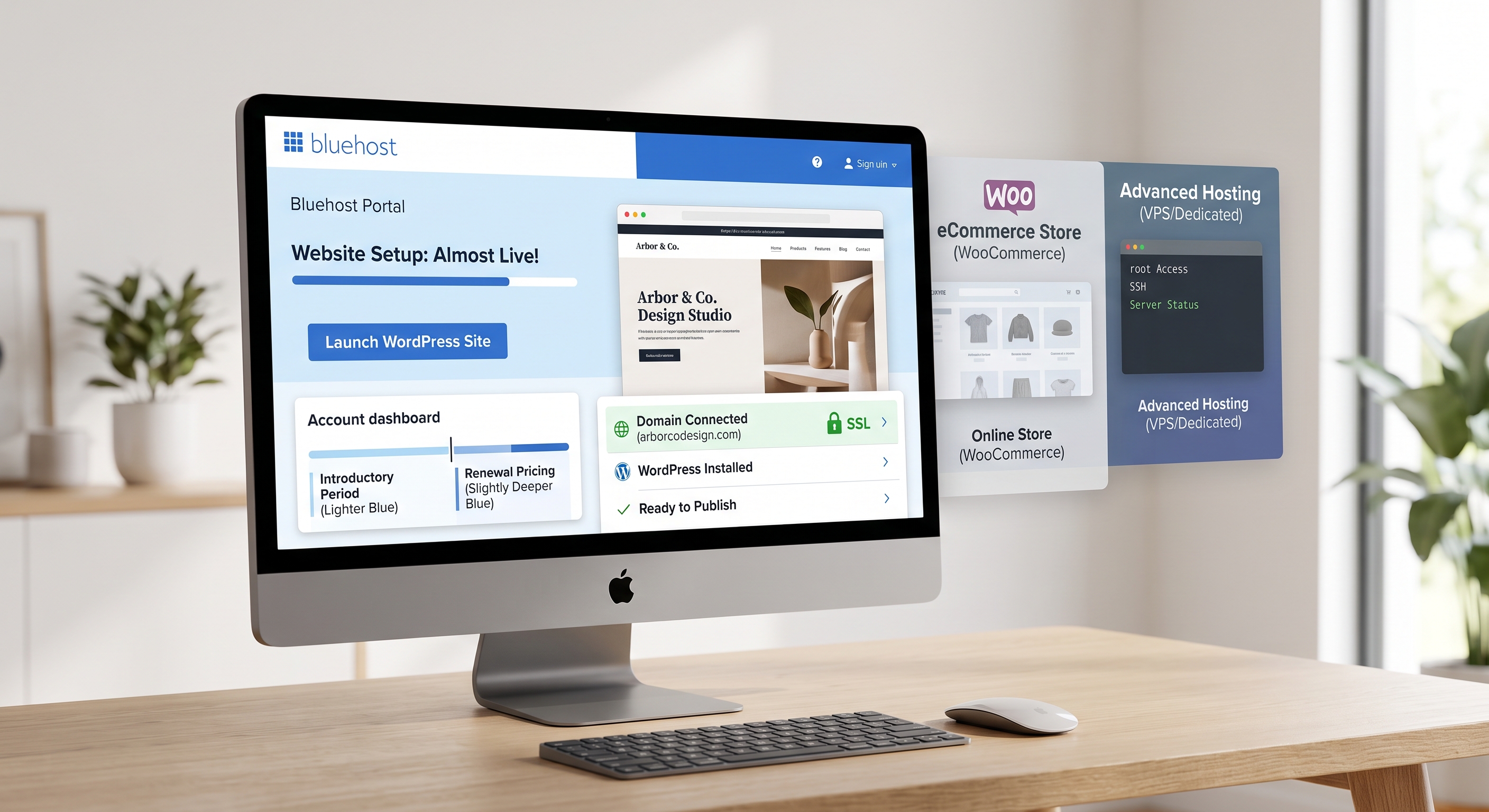
Bluehost is a broad hosting provider with beginner-friendly shared hosting, WordPress and WooCommerce plans, managed services, and self-managed VPS servers. The low introductory prices make it easy to start a site, but the advertised rates require a long prepaid term and the renewal prices are much higher. This research-based review covers the useful parts, the limits that matter after launch, the difference between shared hosting and VPS, and the buyers who should choose another host instead.

Product profile
Bluehost
Inspect Bluehost's BettrList score, current plan summary, product facts, and official link.
BettrList may earn a commission from some outbound product links. This does not affect Bluehost's score, this recommendation, the pros and cons, or the alternatives in this review.
Bluehost review: quick verdict
Bluehost is recommended with caveats. It is a practical choice for a first WordPress site, a small business site, a freelancer managing several low-to-moderate traffic sites, or a new WooCommerce store that wants setup help and common tools in one account. The value is weaker if you need a short commitment, predictable renewal pricing, deep application support, or a managed server without paying for the managed tier. Self-managed VPS is a different product experience. It gives you root access and dedicated resources, but it also makes you responsible for more of the server.
- Best reason to choose Bluehost: fast setup for WordPress, a central portal, free SSL, a free migration tool, and a clear path from shared hosting to VPS.
- Main cost warning: the lowest rates are tied to 36-month shared-hosting or 24-month VPS terms, and the renewal price can change the long-term calculation.
- Best starting point: Starter for one small site, Business for a small portfolio or business with stronger security features, and eCommerce Essentials for a WooCommerce store.
- What to check before buying: the full prepaid amount, the renewal price, backup coverage, support scope, storage needs, and whether you really want to manage a VPS.
What Bluehost is
Bluehost combines several hosting products under one brand. Shared hosting is the simple entry point. You manage sites through the Bluehost portal and use WordPress tools, a site builder, SSL, CDN features, and migration tools. WooCommerce plans add store-focused setup and extensions. VPS plans move closer to infrastructure hosting, with dedicated virtual resources and full root access. That range is useful, but a positive experience on Starter does not tell you what managing a VPS will feel like.
Who Bluehost is designed for
The main audience is a site owner who wants a conventional website online without assembling hosting, WordPress, SSL, CDN, and basic security tools separately. The platform is also aimed at small agencies and business owners who need several sites under one plan. WordPress is the clearest fit because Bluehost provides one-click installation, managed WordPress updates on listed plans, staging, and a WordPress-specific support path.
- A solo consultant launching a brochure site and blog without wanting to manage a Linux server.
- A three-person agency hosting several low-to-moderate traffic client sites under one shared account.
- A small shop that needs WooCommerce, payments, staging, backups, and a guided setup path.
- A technical user who wants a low-cost VPS with root access and is comfortable owning updates, backups, and server configuration.
Main Bluehost features
WordPress setup and site creation
Bluehost makes WordPress the center of the beginner experience. The official material describes instant installation, AI site creation tools, mobile-friendly templates, managed updates on eligible plans, and a free WordPress migration tool. These features reduce the work between buying hosting and publishing a site. They do not remove the need to choose a theme, maintain plugins, check updates, or review the site after a migration. The practical benefit is a shorter setup path, not a fully managed website.
Shared hosting, SSL, CDN, staging, and backups
The shared plans bundle several basics that new site owners often buy separately. The current pricing page lists free SSL, a free CDN, a first-year domain on eligible terms, site migration, staging, malware scanning, and support. Business and commerce plans add stronger security and backup coverage than the lowest entry point. Staging is useful for testing plugin or design changes before pushing them to production. Bluehost's own staging guide also makes clear that later live-site changes do not automatically sync back to staging, so it is not a substitute for a normal backup and release process.
WooCommerce tools
eCommerce Essentials and Premium are built for WooCommerce rather than being ordinary shared hosting with a plugin installed. The plan comparison lists secure payment processing, WooCommerce auto-install, subscriptions, memberships, staging, daily backups, malware protection, a web application firewall, and DDoS protection. Premium adds more store extensions, such as advanced reviews, wishlists, filters, gift cards, product add-ons, and marketplace inventory features. This matters for a store that would otherwise spend time assembling extensions. It is less useful for a simple marketing site that does not sell online.
Self-managed VPS
The self-managed VPS plans provide root access, NVMe storage, AMD EPYC infrastructure, unmetered bandwidth, and a dedicated virtual resource allocation. The NVMe 4 plan listed for this review has two vCPU cores, 4 GB of DDR5 RAM, and 100 GB of NVMe storage. Full root access is valuable for custom stacks, Docker-based tools, and applications that do not fit shared hosting. The trade-off is operational work. Bluehost says self-managed VPS customers have more control, while cPanel and panel support are add-ons. This is a poor choice if you expect the host to handle every server task for you.
How Bluehost works in practice
A typical shared-hosting workflow is straightforward. You choose a plan and term, connect a domain, create a site from the portal, install WordPress or use the site builder, then configure the domain and SSL. If you are moving an existing WordPress site, the self-service migration tool uses a Bluehost plugin powered by InstaWP. For an existing business site, verify forms, redirects, media, email, payments, analytics, and DNS before cancelling the old host.
- Confirm the full term price and renewal price before checkout.
- Create the site and turn on HTTPS before publishing public pages.
- Use staging for theme and plugin changes when the plan includes it.
- Keep an independent backup and test a restore before the site becomes business-critical.
Ease of use and setup
Bluehost earns its beginner-friendly reputation from the guided portal, WordPress installation, templates, and migration workflow. A new owner can get a basic site running without knowing cPanel or the command line. The experience becomes less simple as you add sites, domains, security products, backup choices, and add-ons. VPS is the clearest boundary. It is easy to buy, but not easy to operate without server administration skills.
Bluehost pricing and plans
Bluehost pricing varies by product, term, region, and promotion. The current US pages show these headline prices before VAT or GST. Shared prices below use 36 months. The VPS example uses 24 months. These are hosting-account prices, not per-user or per-seat charges. Introductory pricing is not renewal pricing, and the free domain applies only to eligible 12- or 36-month terms.
Current Bluehost pricing checked August 23, 2026| Plan | Intro price | Term and renewal | Main fit and limits |
| Starter | $3.99/mo | 36 months. Renews at $9.99/mo. | 10 websites, 10 GB NVMe, around 40,000 monthly visits, 24/7 chat. |
| Business | $6.99/mo | 36 months. Renews at $13.99/mo. | 50 websites, 50 GB NVMe, around 200,000 monthly visits, malware scan and removal, staging, chat and phone. |
| eCommerce Essentials | $14.99/mo | 36 months. Renews at $21.99/mo. | 100 websites, 100 GB NVMe, WooCommerce tools, daily backups, staging, store security. |
| Self-Managed VPS NVMe 4 | $9.49/mo | 24 months. Renews at $11.99/mo. | 2 vCPU, 4 GB DDR5 RAM, 100 GB NVMe, root access. cPanel and panel support are add-ons. |
The headline rates require a large upfront payment. For example, Starter is about $143.64 before tax for 36 months, Business is about $251.64, eCommerce Essentials is about $539.64, and VPS NVMe 4 is about $227.76 before tax for 24 months. Bluehost offers a 30-day money-back guarantee for hosting, but the current policy says domain costs and most add-ons are not refunded. The one-month Professional Email trial on eligible plans also auto-renews at the regular rate unless you cancel it before renewal.
Free plan or free trial
Bluehost does not offer a free hosting plan. It offers a 30-day money-back guarantee on hosting, which is a refund window rather than a no-payment trial. A few plans include a one-month Professional Email trial, but that is an add-on trial and it can renew at the regular price. Buyers who only want to test a website idea without paying upfront should look at a free site builder or a host with a true free tier instead.
Important limits and upgrade triggers
- Long-term billing: the cheapest price is tied to a 36-month shared-hosting term or a 24-month VPS term.
- Renewal cost: the post-promotion rate is the more useful number for a site you expect to keep for several years.
- Shared resources: the visit estimates are guidance, not a promise of application performance for every theme, plugin, or traffic pattern.
- Backup detail: Bluehost documents different schedules and conditions by plan. Some courtesy backups can be overwritten, and self-managed KVM VPS users are responsible for their own backups.
- Resource policy: unmetered bandwidth and storage language still sits under acceptable-use rules and database limits.
- Support boundary: basic account and WordPress guidance is available, but custom plugin work, WooCommerce configuration, and advanced remediation may fall outside standard support or require paid help.
Integrations and compatibility
Bluehost is compatible with the normal WordPress ecosystem. The official pages cover WordPress, WooCommerce, Cloudflare CDN, SSL, Yoast SEO, SSH, WP-CLI, staging, email, and payment connections such as PayPal and Stripe on commerce plans. This is enough for a conventional marketing site, content site, or store. It is not the same as a broad SaaS integration platform. If you need a specialized application stack, check PHP, database, cron, SSH, caching, and deployment requirements before selecting shared hosting. The VPS gives you more control, but it also transfers more compatibility work to you.
Security, privacy, and compliance
Bluehost documents server firewalls, mod_security, network flood protections, and DDoS defenses. Shared and commerce plans also list SSL, malware scanning, and, on the higher tiers, malware removal and a web application firewall. Those controls help, but they do not make a website secure by themselves. Bluehost says customers still need strong passwords, current plugins and CMS software, safe file permissions, malware checks, and independent backups. The Newfold privacy notice covers Bluehost as part of the wider Newfold group and explains how personal information and service data are handled. A security-sensitive or regulated organization should still ask for the exact contractual, data-residency, retention, and access-control evidence it needs. The public hosting pages alone are not enough to assume a compliance program fits every regulated workload.
Support and documentation
Bluehost offers 24/7 chat. Its support documentation lists phone support seven days a week from 7 a.m. to midnight Eastern Time. The knowledge base is large and includes current guides for staging, migrations, backups, domains, security, and WordPress. The main limitation is scope. Bluehost can guide account and platform tasks, but it does not promise to manage every theme, plugin, store setting, or application problem. That makes the service more useful for setup and common hosting issues than for a business that expects a host to act as its web development team.
Main strengths
- Beginner-friendly path from domain purchase to a working WordPress site.
- A broad product range that lets a site move from shared hosting to WooCommerce or VPS without changing brands.
- Useful bundled basics such as SSL, CDN, migration tools, staging, and WordPress management features.
- Commerce plans include a strong set of store tools, security controls, and daily backup features.
- Self-managed VPS offers root access and dedicated virtual resources at a lower entry price than managed infrastructure.
Main weaknesses
- The lowest price requires a long upfront commitment, and renewal pricing is materially higher.
- Backup frequency and restore behavior depend on the plan, account size, and backup product. You should keep your own off-site copy.
- The product range can create a confusing upgrade path between shared hosting, managed services, commerce add-ons, and self-managed VPS.
- Support is helpful for platform guidance but does not replace WordPress maintenance, plugin troubleshooting, store configuration, or server administration.
- The budget VPS is attractive only if you can handle root access and the operational work that comes with it.
Best use cases
Choose Bluehost when you want a familiar WordPress starting point, need several conventional websites under one account, or want a store-focused plan that bundles common WooCommerce tools. It is also reasonable for a developer who wants a low-cost VPS and understands the difference between buying a server and receiving a managed service. In all of these cases, decide from the renewal price and backup plan rather than the first-year headline alone.
Poor-fit use cases
Bluehost is a poor fit for a regulated workload that needs documented enterprise controls and a clearly scoped contract before launch. It is also a poor fit for a team that wants month-to-month predictability, full application-level support, or a host that owns all server maintenance. A high-traffic application with unusual runtime requirements should start by checking the technical limits. Shared hosting may be too constrained, while self-managed VPS may demand more operations work than the team wants to own.
Bluehost alternatives
Hostinger is worth comparing if the main goal is the lowest introductory price and a similar beginner-focused workflow. Kinsta is a better direction for a business WordPress site that values managed operations, staging, and higher-touch support over entry-level cost. DigitalOcean is more suitable when you want cloud infrastructure control and are comfortable managing the application and server yourself. The right alternative depends on whether your main constraint is price, managed service, or technical control.
Final verdict
Bluehost is a sensible starting host for many small websites, but it is not automatically the best long-term value. Choose Starter when you are launching a small site and can accept the renewal price. Choose Business when you need more sites, storage, staging, and security features. Choose eCommerce Essentials when the store tools and daily backups justify the higher cost. Choose self-managed VPS only when root access matters and you are ready to manage the server. If any of those conditions do not match your situation, compare a shorter-term, more managed, or more specialized host before paying for a long term.