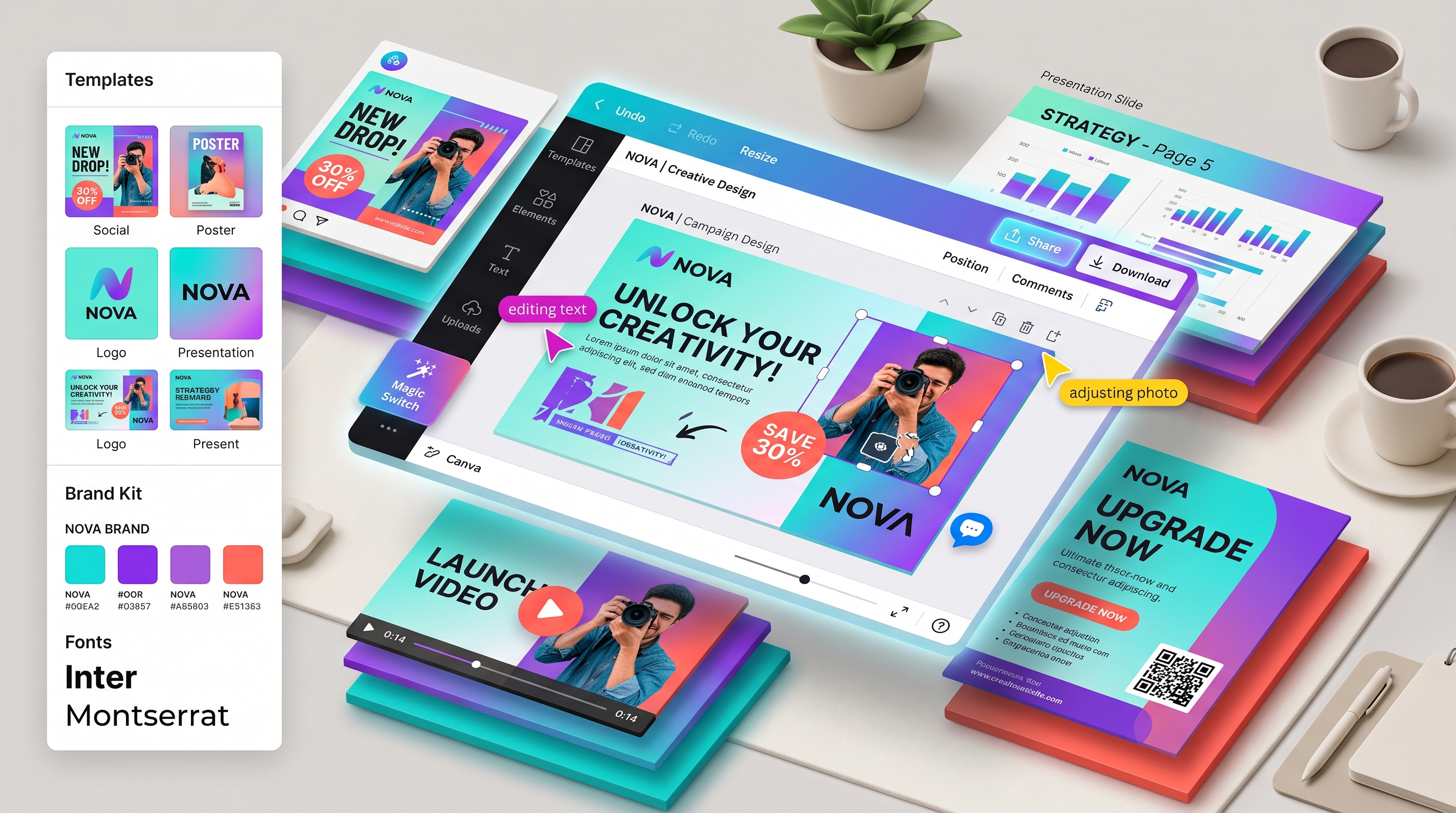
Canva is a broad visual content platform that helps people make social graphics, presentations, videos, documents, websites, and print designs without starting from a blank canvas. The free plan is genuinely useful, while Pro and Business add premium assets, brand controls, storage, collaboration, and larger AI allowances. This research-based review looks at where Canva earns a paid subscription, where its breadth creates trade-offs, and which buyers should choose a more focused design tool instead.
Product profile
Canva
Inspect Canva’s BettrList score, existing plan summary, product facts, and official link.
Canva review: quick verdict
Canva is recommended with caveats. It is a strong fit for solo creators, freelancers, marketing teams, and small businesses that need polished visual content quickly and do not want a specialist designer for every asset. Free is enough for many occasional users. Pro is the sensible paid plan for one frequent creator. Business makes more sense when several people need shared brand assets and team administration. Canva is not a universal design system, though. Product design teams, teams that need deep vector or interface workflows, and organizations with strict data-location requirements should evaluate alternatives before standardizing on it.
- Best reason to choose Canva: one approachable workspace covers many common visual jobs, from a social post to a presentation or short video.
- Main weakness: the large template and AI surface can encourage generic output, extra configuration, and recurring add-on decisions.
- Best starting point: Free for occasional work, Pro for one active creator, and Business for a real multi-person brand workflow.
- What to check first: the exact premium assets you need, the number of people who will edit, AI usage expectations, and whether US data storage fits your policy.
What is Canva?
Canva is an online visual communications and publishing platform. Its editor uses templates, drag-and-drop layout tools, stock media, text, animation, video, presentations, and export options to help a user turn an idea into a finished asset. The product is not only a graphics editor. The current plan comparison also covers presentation modes, social sharing, print-ready export, content scheduling, AI tools, brand management, and access to Affinity on paid plans.
Who is Canva designed for?
Canva is designed for people who need to produce visual work as part of another job. That includes a solo consultant making proposals and social posts, a freelancer preparing client deliverables, a three-person agency managing campaign assets, a small business owner creating local promotions, and a marketing team that needs shared templates and approvals. It is also useful for teachers, nonprofits, and community organizations because the free tier lowers the barrier to occasional design work and the pricing page lists special access for some educational and nonprofit organizations.
It is less suitable as the main tool for a product design team that needs component libraries, precise interface handoff, or detailed interaction prototyping. It is also a poor default for a security-sensitive organization that has not reviewed Canva’s stated US storage and international transfer model. Canva publishes useful controls, but a published control set is not the same as approval for every type of data.
Canva features that matter in practice
Templates and a forgiving editor
The editor is built around templates and a visual canvas rather than a technical design workflow. The public pricing page lists more than 1.6 million templates on Free and more than 3.6 million on Pro and Business, along with a much larger premium media library on paid plans. The practical benefit is speed. A non-designer can start from a structure that already has sensible spacing and hierarchy, then adapt the copy, colors, images, and dimensions. The trade-off is that the fastest path can produce familiar-looking work, so teams need a clear brand system and a willingness to edit beyond the first template.
Brand Kits and team controls
Free includes one Brand Kit limited to three brand colors. Pro expands that to five Brand Kits. Business expands it to 100 Brand Kits and adds approvals and team administration. This is more important than the raw number of kits suggests. A solo creator needs quick access to a logo, palette, and fonts. An agency or growing marketing team needs to keep client and campaign assets separate, review work before publishing, and reduce the risk of using an outdated logo. Business becomes easier to justify when several people create content often, not simply because the team has more than one Canva login.
AI tools with a real usage boundary
Canva includes AI tools across its plans, but the usage model needs attention. The public pricing page describes Free as having up to 200 Standard AI uses or 20 Premium AI uses and shows Pro at ten times more AI than Free and Business at twenty times more. Canva’s AI Pass page explains that Standard, Premium, and Ultra tools share a pool and that usage depends on the mix of tools. AI Design tools sit outside that allowance under fair-use limits. This is useful for occasional ideation and production, but heavy users need to track the allowance instead of treating AI as unlimited. AI Pass is a recurring add-on to Pro or Business, and the public page checked did not show a fixed price.
How Canva works in practice
A normal Canva workflow starts with a template or a blank design, then moves through editing, collaboration, review, and export. The product is strongest when the output is a repeatable communication asset rather than a complex design system. A sensible small-team workflow is:
- Set the output and audience first. Choose the actual format, channel, and required dimensions before browsing templates.
- Load the correct Brand Kit or team folder. This reduces the chance of mixing client assets or old campaign material.
- Adapt the structure instead of accepting the first template unchanged. Replace stock images, rewrite generic copy, and check contrast and reading order.
- Use comments, approvals, or shared links when another person needs to review the work. Do not assume that a shared link is private once it is forwarded.
- Export and check the final file in the place where it will be used. A design that looks fine in the editor can still need a final check for crop, animation, print, or mobile display.
Ease of use and setup
Canva is easy to start because the editor gives users visible choices and immediate feedback. Most of the setup work appears later, when a team wants consistent naming, folders, permissions, Brand Kits, approvals, and a safe AI policy. A solo user can stay productive with little administration. A team should spend time deciding who owns brand assets, who can approve designs, which links may be public, and which source files may be sent to AI tools. Canva’s simplicity is real, but shared simplicity still needs operating rules.
Canva pricing and plans
The table below uses the public US pricing display checked on August 16, 2026. Prices are shown in USD. Pro and Business offer lower monthly equivalents when billed yearly, while monthly billing costs more. Pro is for one person. Business is priced per person and adds team features. Enterprise is custom. Regional checkout prices, taxes, trial terms, and promotional offers can vary, so confirm the final amount before purchase.
Canva public plans checked August 16, 2026| Plan | Price | Billing unit | Main use | Important limits and upgrade triggers |
| Free | $0 | One person | Occasional design and basic visual content | 1 Brand Kit with 3 colors, 5GB storage, smaller asset library, and lower AI allowance |
| Pro | $144/year ($12/month equivalent) or $18/month | One person | Frequent solo creator or freelancer | 5 Brand Kits, 100GB storage, premium assets and tools, larger AI allowance; monthly billing costs more |
| Business | $250/user/year ($20.83/user/month equivalent) or $25/user/month | Per user | Small team with shared brand and admin needs | 100 Brand Kits, approvals, team tools, 500GB storage, larger AI allowance; each active user adds cost |
| Enterprise | Custom pricing | Organization agreement | Larger organization with governance needs | Contact Sales for custom controls, security review, support, and commercial terms |
Do not compare Canva Pro and Business only by the monthly headline. Compare the number of active users, the value of shared Brand Kits and approvals, the storage allowance, the AI allowance, and any AI Pass add-on before choosing a plan.
Free plan and free trial
Canva Free is one of the product’s strongest reasons to try it. It gives one person a large template and media collection, a drag-and-drop editor, one limited Brand Kit, 5GB of storage, and a monthly AI allowance. It is enough for occasional posts, simple presentations, event graphics, and early experimentation. The pricing page shows free-trial entry points for Pro and Business. Treat those as an opportunity to test a real workflow, not proof that a trial will always have the same duration or renewal terms. Check the checkout screen and cancellation date.
Important limits and upgrade triggers
- Premium assets and tools: background removal, resize, translate, and the larger premium library are paid-plan reasons. Upgrade when these tools solve a repeated production task, not because the feature list is long.
- Storage: Free includes 5GB, Pro includes 100GB, and Business includes 500GB on the current public plan comparison. Asset-heavy teams should estimate uploads and exports before moving shared work into Canva.
- Brand management: Free is limited to one small Brand Kit, Pro has five, and Business has 100 with approvals. Multi-client agencies may reach this boundary through organization and review needs rather than design volume.
- AI usage: the allowance is shared across Standard, Premium, and Ultra tools and varies by tool. Heavy AI use can trigger pauses, a plan comparison, or the separate AI Pass add-on.
- Team billing: Pro is a one-person plan. Business is priced per user, so a three-person team should budget for three seats instead of treating one subscription as a shared login.
- Privacy and sharing: designs are private by default, but public or link-based sharing changes the exposure. A forwarded link can reach people outside the original review group.
Integrations and compatibility
Canva works well as a visual layer around other tools. The official integration guidance describes Slack and Microsoft Teams apps for notifications, tags, comments, invitations, previews, and design sharing. Canva also provides an Apps SDK for in-editor apps and Connect APIs for integrations that exchange designs, templates, assets, and data with another platform. This is useful for a marketing stack or content workflow that needs Canva without constant app switching.
The important limitation is that an integration is not automatically a full two-way production system. The Developers page says some Connect APIs are restricted to paid plans and that preview APIs can change. Teams should check the exact integration, permissions, plan requirement, and data flow before making it a core dependency. Canva’s app ecosystem extends the product, but it also introduces third-party terms and privacy policies for some apps.
Security, privacy, and compliance
Canva’s security page says designs are protected in transit with TLS/SSL and at rest with AES-256. It also lists SSO and MFA options for users and enterprises, role-based access, logging and alerting, staged releases, and a bug bounty program. Canva’s Trust and Security Portal lists SOC 2 Type 2, ISO/IEC 27001, PCI DSS, and EU-US Data Privacy Framework material, along with additional reports and assessments available through the portal.
The privacy trade-off needs equal attention. Canva’s Trust Center says it stores user data in the United States and processes data across several countries under transfer safeguards. It says default designs are private, but anyone with a public link may access a design. The privacy page also describes settings that control whether user content can improve AI-powered features. Business users have different controls from individual users, and Canva says third-party apps in its marketplace follow their own terms and privacy policies. A team handling client, personal, legal, or unreleased information should review the DPA, data flows, sharing defaults, AI settings, and approved apps before rollout.
Canva publishes credible security and privacy material, but “secure” is not the same as “approved for every data type.” The buyer still owns the decision about data location, sharing, retention, AI use, and third-party apps.
Support and documentation
Canva’s public support path is the Help Center, supported by product documentation and account guidance. The documentation is useful for common plan and workflow questions. Business and Enterprise buyers can also use the sales and trust channels when procurement needs more detail. The practical limit is that the public sources reviewed do not promise the same support level for every plan. If a team needs a named account contact, contractual response targets, or procurement evidence, ask for those terms before standardizing on Canva.
Main strengths
- The Free plan is useful enough for real occasional work, not just a trial screen.
- Templates, stock assets, exports, presentations, video, and social workflows cover many common small-business jobs in one place.
- Pro gives one frequent creator a clear upgrade path with premium tools, larger storage, Brand Kits, and more AI usage.
- Business adds shared brand management, approvals, and administration that matter to small teams and agencies.
- Canva publishes meaningful security, privacy, compliance, and developer information for buyers who need more than a simple editor.
Main weaknesses
- The broad template-driven workflow can lead to generic output unless someone owns brand and editorial quality.
- Business pricing scales per user, so the recurring cost becomes material as more people need edit access.
- AI usage is bounded and shared across tool tiers, while the extra AI Pass cost is separate from Pro or Business.
- US storage and international processing may not fit a team with strict data-location or client-contract requirements.
- Canva is less compelling for specialist interface design, deep vector control, complex publishing systems, or self-hosted workflows.
Best use cases and poor-fit use cases
Canva is most convincing for a solo creator who needs weekly social graphics, a freelancer preparing polished client deliverables, a small business owner producing local promotions, and a marketing team that wants shared templates and approval steps without building a design operations system. It also works well for presentations, lightweight video, event materials, and repeatable campaign assets where speed matters more than specialist control.
Canva is a poor fit for a product design team that depends on detailed interface prototypes, design-system governance, or developer handoff. It is also a poor fit for an organization that cannot accept Canva’s stated data storage and transfer model, or for a creator who needs advanced illustration, motion, or print production control. In those cases, a focused specialist tool may reduce compromise even if it has a steeper learning curve.
Canva alternatives
Choose Figma when the main job is interface design, collaborative product work, prototyping, or design-system handoff. Choose Adobe Express when the team already works deeply in Adobe’s ecosystem and wants a simpler content tool around that workflow. Choose Affinity or another specialist desktop tool when precise illustration, photo editing, or layout control matters more than a browser-first template library. Choose PowerPoint or Google Slides when presentations are the only real need and the team already owns those tools. These alternatives solve different problems, so the right choice depends on whether Canva’s breadth is saving tool switches or creating a layer of compromises.
Decision scenarios
The scenarios below focus on the buyer’s actual workflow. They are based on Canva’s public plan, security, privacy, integration, and support information, not on a private account test.
Final verdict
Canva earns a recommendation with caveats. It is one of the easiest ways for a freelancer, creator, agency, or small business to produce a steady stream of usable visual content. Free is the right starting point for occasional work. Pro is the practical paid choice for one active creator. Business earns its premium when shared Brand Kits, approvals, storage, and team administration solve a real coordination problem.
Do not buy Canva only for its feature count. Start with Free or a trial, make the actual assets your team needs, check premium content and AI usage, and decide whether the resulting work is distinctive enough for your brand. Before using it for sensitive client or internal material, review the storage location, privacy controls, shared-link behavior, AI settings, DPA, and third-party apps. If your work is mainly product UI, specialist illustration, or strict data-governed production, compare a focused alternative first.