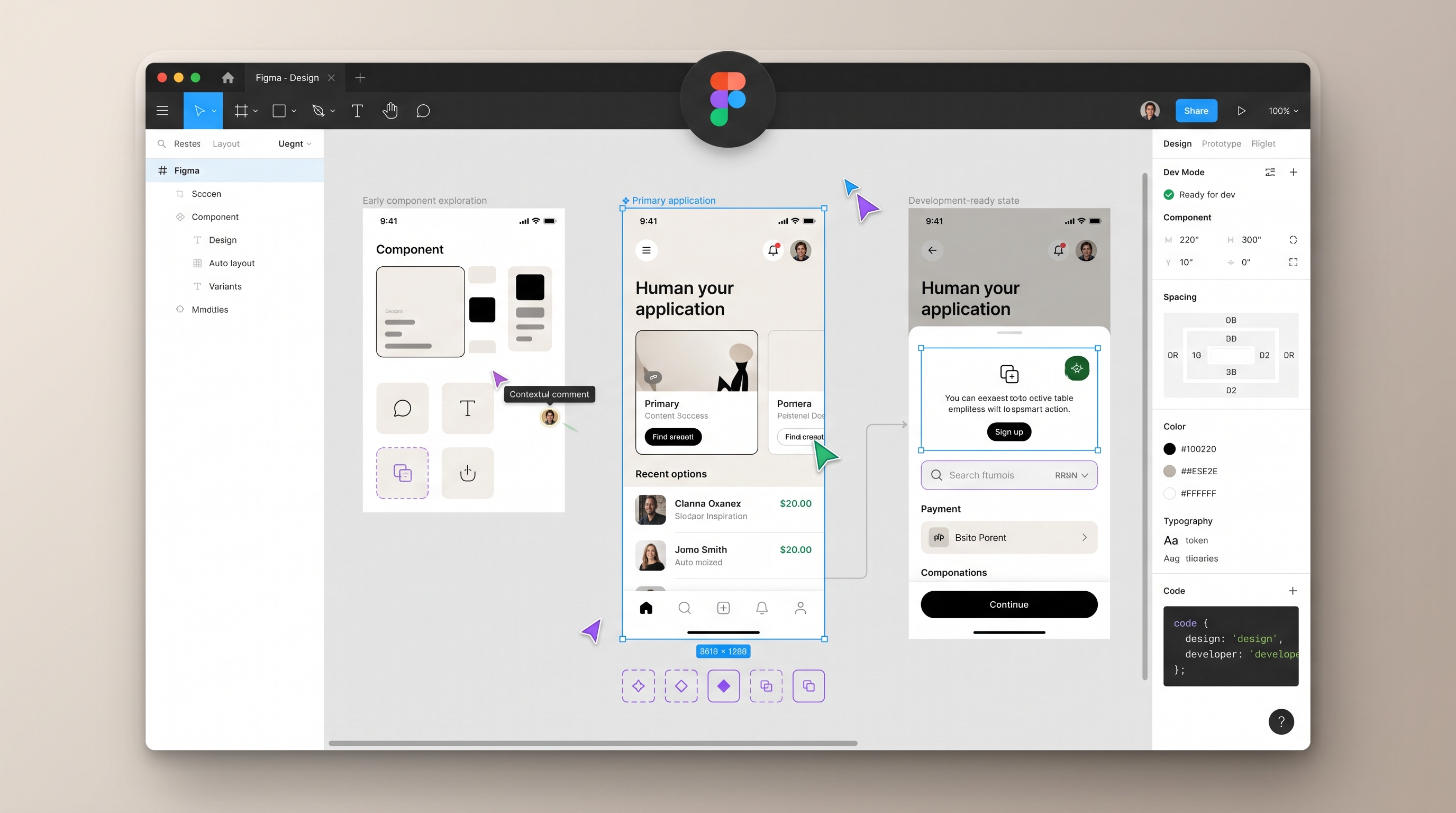
Figma is a strong choice for teams that design digital products together. Its main advantage is the connected workflow: designers can build interfaces and prototypes, stakeholders can comment in the same files, and developers can inspect the work without waiting for a separate handoff package. FigJam, Figma Slides, Figma Make, plugins, APIs, and AI tools extend that workspace beyond interface design.
The cost and complexity rise with the team. Starter is useful but limited. Professional is priced per seat. Organization and Enterprise add central administration and security controls, not simply more drawing tools. Figma also treats AI as a credit-based feature, so teams should budget for usage instead of assuming that AI is unlimited.
Research-only review: this assessment is based on current Figma pricing, product documentation, developer documentation, security material, privacy terms, and public support pages checked on the date shown. We did not use a private Figma account or claim hands-on workflow results.
Quick verdict
Choose Figma if your work involves interface design, prototypes, design systems, and regular collaboration with developers or clients. The product is especially compelling when one shared workspace can replace a separate whiteboard, prototype tool, handoff tool, and presentation workflow.
Start on Starter if you are learning or working on a small number of files. Professional is the practical paid plan for a freelancer or one small design team. Organization is for work across multiple teams. Enterprise is a governance purchase for larger organizations. Avoid choosing Figma just because it is popular. If your main job is template-led marketing content, a simpler tool may deliver better value.
- Best fit: product designers, design engineers, agencies delivering interface work, and teams that review designs in real time.
- Main trade-off: deep flexibility and broad collaboration create more file, library, permission, and seat decisions.
- Reader action: test a real project on Starter, then price the exact seat mix before assigning paid access to a team.

Product profile
Figma
See the current Figma score, plan summary, platform details, and product-level facts before choosing a review scenario.
What Figma is
Figma is a collaborative design platform built around shared files and a multiplayer canvas. Figma Design covers interface layouts, components, prototypes, variables, and design libraries. FigJam is the whiteboard layer for brainstorming, diagrams, workshops, and planning. Figma Slides brings presentations into the same environment, while Figma Make and other AI features help turn prompts or existing design context into early ideas and prototypes.
The important distinction is that these products share an account and plan structure, but they do not all serve the same user. A designer may need a Full seat. A developer may only need a Dev seat. A project manager or client may use a free View seat. A team should decide who needs to edit, who needs Dev Mode, and who only needs to review before buying seats.
Who Figma is designed for
Figma is designed for work where the visual artifact is part of an ongoing conversation. It is a good match when several people need to look at the same design, leave context beside it, and keep changes visible as the work moves toward implementation.
- UI and UX designers building websites, mobile apps, dashboards, and design systems.
- Product teams that need prototypes, design reviews, and shared component libraries.
- Developers who need inspectable measurements, assets, code snippets, statuses, and links to implementation resources.
- Agencies that need a common review space for clients, designers, and engineers across recurring projects.
- Facilitators and product teams that use FigJam for workshops, diagrams, planning, or retrospectives.
Main features and why they matter
Collaborative canvas and reusable components
The core editor combines a flexible canvas with components, auto layout, styles, variables, and prototypes. Multiple editors can work in the same file with live cursors and comments. The practical benefit is less file passing and less uncertainty about which version a reviewer is seeing. The limitation is that the workspace does not organize itself. Teams need naming rules, ownership, and a clear distinction between working files, shared libraries, and approved components.
Prototyping and design systems
Figma prototypes can simulate navigation, overlays, transitions, variables, and conditional logic. Team libraries let people reuse components and styles instead of redrawing common patterns. Organization and Enterprise add broader design-system and cross-team capabilities. These tools matter when a team is validating flows or building more than one screen. They matter less if the goal is a quick one-off graphic with no product workflow behind it.
Dev Mode and handoff
Dev Mode gives developers a focused view of designs marked ready for development. The documentation lists inspection of layout and spacing, code snippets, assets, annotations, version comparison, component information, developer links, and Code Connect. This does not generate finished production code for a team. It gives engineers a shared reference and reduces the amount of context lost between design and implementation. Dev Mode requires the right plan and seat for advanced access, although viewers can still inspect basic information.
FigJam, Slides, Make, and AI
FigJam is useful when a product team wants brainstorming and design work close together. Slides can include live prototypes, polls, and presentation content. Figma Make and Figma AI can help with early exploration, but these features introduce a separate judgement problem. AI output can be wrong, credits vary by request, and admins control whether customer content is used for model training. Treat AI as an accelerator for ideas and repetitive work, not as a replacement for design review or engineering checks.
How Figma works in practice
A useful Figma workflow usually moves through the same shared file rather than a chain of exports. The exact process varies by team, but the product is strongest when the design, review, and handoff context stay connected.
- Start with a draft, template, or existing component library. Keep early exploration separate from the team’s approved system.
- Build the flow with components, auto layout, variables, and prototype interactions so reviewers can respond to a realistic experience.
- Use comments, cursors, workshops, and presentation views to gather feedback in the design context instead of copying screenshots into another tool.
- Mark the right frames ready for development. Use Dev Mode, annotations, links, assets, and version comparison to give engineering a current reference.
This flow can replace several handoff habits, but it does not remove the need for product decisions. Someone still needs to decide which component is approved, which feedback is actionable, and which design version engineering should build. Figma makes that work visible. It does not make it automatic.
Ease of use and setup
The first experience is approachable. A new user can open a file, draw a layout, import an asset, share a link, and add a comment without learning a large administration system. Community templates and UI kits reduce the blank-canvas problem. That is why Figma can work for a freelancer as well as a formal product team.
The harder part begins after the first project. Teams need to choose where work lives, who can create teams, which libraries are official, how drafts become shared files, and which seat type each person needs. Variables, branching, permissions, and plugins add real power, but they also create more ways for a workspace to become inconsistent. A short internal guide is worth writing before a team grows beyond a few people.
Pricing and plans
Figma prices access through plans and seats. The current public comparison lists four plans in USD. Professional has Full, Dev, and Collab seats with monthly and annual options. Organization and Enterprise are billed annually in the public comparison. View access can be free on paid plans, but editing still depends on both permission and the correct seat.
Current public plan structure checked on the review date| Plan | Public price | Best use | Important limits or conditions |
| Starter | Free | Learning, drafts, and a small shared project | Three shared Design or Sites files in a folder, one folder, 30 days of version history, limited team features |
| Professional | $16/mo annual Full seat; product record lists $20/mo monthly | Freelancers and one small design team | Per-seat cost, one team, unlimited files and folders, 3,000 AI credits per Full seat/month |
| Organization | $55/mo annual Full seat | Businesses designing across multiple teams | Annual billing, centralized admin, unlimited teams, 3,500 AI credits per Full seat/month |
| Enterprise | $90/mo annual Full seat | Multiple products or brands with advanced governance | Annual billing, custom workspaces, SCIM, broader governance, 4,250 AI credits per Full seat/month |
Seat choice is the pricing detail most likely to change your budget. The pricing page lists Professional Dev at $12/month and Collab at $3/month on the annual view. Organization lists Dev at $25 and Collab at $5. Enterprise lists Dev at $35 and Collab at $5. The person who only reviews a file may need no paid seat. The person who edits a design needs both edit permission and an appropriate seat.
Annual billing is not the only condition to check. Professional can be monthly or annual, while Organization and Enterprise are annual in the public comparison. New seats can be prorated and invoiced during a term. Taxes, extra AI credits, and any contract terms are not included in the headline figures. Price the actual mix of Full, Dev, Collab, and View users before making a plan decision.
Free plan or free trial
Figma has a useful free Starter plan instead of relying only on a time-limited trial. The published limits are meaningful. A Starter team has one folder and three shared Figma Design and Figma Sites files in that folder, while drafts are unlimited. Version history is limited to 30 days. That is enough to learn the editor and test a small workflow, but it is not a safe long-term home for a growing product team. Eligible students and educators may qualify for free Professional or Enterprise access through the Education plan.
Important limits and upgrade triggers
- Starter file and folder limits become a problem once a team has several active projects or needs a stable shared library.
- Version history moves from 30 days on Starter to unlimited on paid plans, which matters when a team must recover or compare older work.
- Professional is still built around one team. Multiple product groups and centralized ownership point toward Organization or Enterprise.
- AI uses shared credits. Included amounts depend on plan and seat, and extra credits are a separate add-on.
- Advanced administration such as SSO, activity logs, link controls, SCIM, custom workspaces, and external-content restrictions is plan-dependent.
- A paid seat does not automatically grant edit permission. Teams can overspend and still confuse seat access with file permissions.
Integrations and compatibility
Figma has a broad extension surface. The official pricing page lists plugins, widgets, third-party integrations, live embeds, webhooks, and an MCP server. Figma’s developer documentation separates the Plugin API, Widget API, and REST API. Plugins can work inside the open file, widgets add collaborative objects to a canvas, and the REST API supports automation and access to files, images, comments, variables, webhooks, and analytics-related resources.
The practical benefit is that Figma can connect to project tracking, documentation, code, and automation workflows. The trade-off is that every plugin or integration becomes another permission and data-flow decision. For a small team, start with the integrations that solve a visible handoff problem. Do not install a large plugin collection just because the marketplace makes it easy.
Security, privacy, and compliance
Figma publishes a mature security and compliance program. Its security page lists SOC 2 Type 2, SOC 3, ISO 27001, ISO 27018, ISO 27701, ISO 42001, and additional programs. The Trust Center provides certificates and documents covering access management, data retention, incident management, disaster recovery, vulnerability handling, VPATs, and other controls. Organization and Enterprise plans add stronger administration such as SSO, activity logs, link restrictions, SCIM, and external-content controls.
Privacy still needs a buyer-specific review. Figma’s privacy policy covers customer content, usage data, account information, service providers, and public sharing. Its AI material says customer-content training is optional and that the default differs by plan. Starter and Professional are described as on by default with an admin opt-out, while Organization and Enterprise are off by default. This is an important distinction for teams handling confidential client work. Review sharing, plugins, public links, content training, data location, retention, and contract terms before uploading restricted material.
Support and documentation
Figma has strong public documentation for a design product. The Help Center covers core products, files, permissions, billing, organizations, AI, and troubleshooting. Developer documentation covers plugins, widgets, REST APIs, and integration patterns. There is also a community forum and a support request path. The limitation is not a lack of material. It is that public documentation does not tell a small buyer what account-level support or response expectations will apply to a particular contract. Confirm that during procurement if the workflow is business-critical.
Main strengths
- Real-time collaboration keeps design, feedback, and review context in the same place.
- Components, variables, libraries, and prototypes support a serious product-design workflow.
- Dev Mode gives developers current inspection, assets, annotations, version comparison, and implementation links.
- Starter is useful for learning and small projects, so teams can test the core workflow before paying.
- The extension platform connects Figma to plugins, widgets, APIs, webhooks, code, and external tools.
- Public security and compliance documentation is stronger than many lightweight design tools provide.
Main weaknesses
- Per-seat pricing grows quickly when many people need edit access or advanced product access.
- Starter’s shared-file and version-history limits make it a test plan, not a comfortable home for a growing team.
- The flexible workspace needs governance. Without naming, library, and permission rules, teams can create duplicate or unclear sources of truth.
- AI credits and optional add-ons make the total cost less predictable for teams that use AI heavily.
- Security controls and ownership features vary by plan, so a positive compliance posture does not remove procurement work.
- Figma is more tool than some small businesses need when the main job is quick marketing graphics rather than product design.
Alternatives
Canva is the more natural comparison when the work is social content, presentations, simple video, and template-led marketing production. Sketch is worth considering for teams that prefer a Mac-focused native design workflow. Penpot is worth investigating when open-source licensing or self-hosting is central to the decision. These are not interchangeable products. Choose based on the work your team repeats every week, not on the size of the feature list.
Final verdict
Figma earns a Recommended with caveats verdict. Its strongest case is a product team that needs one shared place for interface design, prototypes, design systems, review, and developer handoff. The free plan makes the first test low risk. Professional is a sensible paid starting point for a freelancer or small team, especially when the team prices Full, Dev, Collab, and View access carefully.
Avoid Figma when your work is mostly routine marketing graphics, when per-seat cost is hard to control, or when the organization cannot accept the data and AI settings of the proposed plan. Before paying, put one real project on Starter, invite the people who will review it, check the handoff path with a developer, and then model the exact seats and governance controls you need. That test will tell you more than a generic feature comparison.