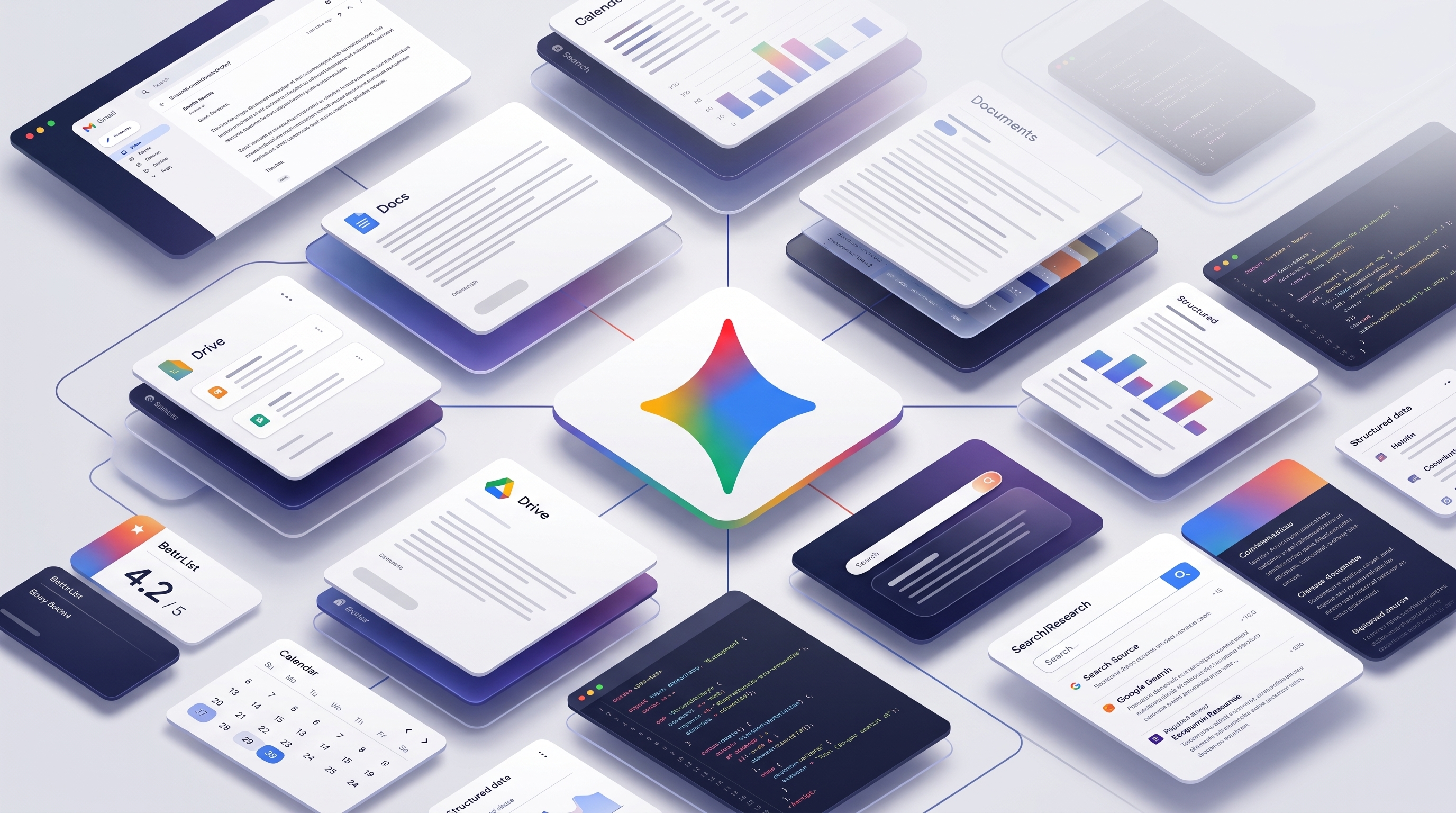
Gemini is Google’s AI assistant for chat, research, writing, coding, file analysis, image and video generation, and connected work across Google services. Its strongest advantage is context. Gemini can sit close to Gmail, Docs, Drive, Chrome, Search, and Google One storage. The main drawback is that plans and account types differ. Usage limits change, premium features vary by region, and personal Gemini is not the same thing as Workspace Gemini or the Gemini API. This research-based review explains which plan fits which situation.

Product profile
Gemini
See Gemini’s BettrList score, current plans, platform coverage, and product facts.
BettrList may earn a commission from some outbound product links. This does not affect Gemini’s score, recommendation, pros, cons, or alternatives.
Gemini review: quick verdict
Gemini is recommended with caveats. It is a good choice for a solo professional, student, creator, or developer who already works in Google services and wants an assistant that can handle research, drafting, long files, coding, and connected tasks. Free is a useful starting point, Plus is an inexpensive way to get more room, and Pro is the sensible paid plan for regular individual work. Ultra can make sense for heavy users, but $99.99 or $199.99 per month is a specialist price. The decision is not universal because personal-plan privacy settings, account type, regional availability, and compute-based limits matter as much as model quality.
- Best reason to choose Gemini: it connects an AI assistant to the Google tools many people already use every day.
- Main weakness: the plan names hide a complex limit and feature matrix, and paid access still does not mean unlimited use.
- Best starting point: Free for occasional work, Plus for a low-cost step up, and Pro for regular individual writing, research, and file work.
- What to check first: your Google account type, privacy settings, region, expected usage, storage needs, and whether you really need an app subscription rather than the API.
What is Gemini?
Gemini is a general-purpose AI assistant available through a web app, mobile apps, Chrome features, and Google product integrations. You can use it to brainstorm, explain a topic, summarize files, draft text, analyze data, research a question, generate images, and write or review code. Google also offers features such as Canvas, Gems, Deep Research, Gemini Live, and newer creative or agentic tools that may have different plan and regional requirements.
There are three boundaries buyers should understand. A personal Google Account can use the consumer Gemini app and Google AI subscriptions. A work or school account depends on the organization’s Workspace edition and administrator settings. The Gemini API has its own billing, rate limits, credentials, and data terms. A Google AI Pro subscription does not give a developer a pool of API tokens for a product.
Who is Gemini designed for?
Gemini is designed for people who already spend time in Google’s ecosystem. A solo consultant can summarize Gmail threads and draft a client document. A student can turn notes into study material. A creator can use image and video tools alongside Drive storage and YouTube benefits. A developer can use Gemini for code explanations and Google’s coding tools.
It is less suitable when you need a neutral, tool-independent assistant, a predictable unlimited quota, a centrally managed team subscription, or an approved environment for sensitive client data without checking the account and Workspace model. It is also a poor fit if you want API access inside your own product. That is a separate Google AI for Developers workflow.
Gemini features that matter in practice
Google app connections
Gemini can work with Gmail, Calendar, Docs, Drive, Keep, Tasks, Chat, and Classroom when account, app, region, language, and administrator settings allow it. This is what most clearly separates Gemini from a standalone chat window. You can ask it to find an email or summarize a document without moving every piece of context into another tool.
The connection is not the same as full control of the underlying apps. Google’s documentation lists important limits. Gemini may not access every kind of Drive media, may not manage folders, may not create or delete every document type, and may not see comments or images in some Workspace files. For work accounts, the administrator controls whether connected apps are available. The feature is useful, but you should verify the exact action before promising automation to a client or team.
Research, files, and long context
Deep Research can gather and synthesize sources, while file uploads and long context support analysis of notes, plans, transcripts, and code. Google’s current plan material highlights a 1M-token context window for Pro and Ultra. That is valuable when the job is to compare a large set of documents or reason across a long repository. It does not guarantee a correct answer. Google itself tells users to check responses because Gemini can be inaccurate or out of date.
Canvas, Gems, image and video generation
Canvas gives a more structured space for documents, code, and other outputs. Gems let you create customized versions of Gemini for repeated instructions or specialized tasks. Paid plans add more access to image and video generation, as well as tools such as Flow. These features can reduce the number of separate creative tools a user needs. The trade-off is that media generation consumes more usage and may be limited by plan, demand, age, region, and availability.
Coding and developer workflows
Gemini can explain code, suggest changes, generate tests, and work with large code inputs. Google’s current subscription page also lists Jules and Google Antigravity for higher-tier coding workflows. These are useful when the developer already uses Google’s ecosystem, but they do not remove the need for code review, local tests, security checks, or license review. The separate Gemini API is still the correct route for product features and server-side model calls.
How Gemini works in practice
The normal workflow starts with a prompt in the web or mobile app. You can attach files, ask for a draft, refine the answer, request a research report, or mention a connected app. The useful part is the iterative flow. You can begin with a broad question, ask Gemini to show sources or explain its reasoning, then turn the result into a document or another structured output. The important operational step is review. Treat the response as a draft or research aid, not as an automatically verified record.
- Start with a low-risk recurring task such as summarizing internal notes or preparing a first draft.
- Ask Gemini to identify sources, assumptions, and uncertain points before you reuse the output.
- Keep confidential material out of a personal account until your organization has checked Keep Activity, connected apps, and Workspace rules.
- Watch the usage notice and the plan refresh time. A paid plan can still reach a model or feature limit.
Ease of use and setup
Gemini is easy to start because a Google Account provides a Free entry point and the web app works in common browsers. Existing Google users do not need a new identity system or separate storage service. The experience becomes more complex with Workspace apps, Chrome features, activity settings, or personal and work accounts. A business workflow still needs account ownership, permission, retention, and review rules.
Gemini pricing and plans
The figures below are US consumer prices checked on August 16, 2026. Google says plan availability and some benefits vary by country, age, language, account, device, and feature rollout. Google AI Plus, Pro, and Ultra are personal subscription products. The current Product record stores Ultra as two plan entries, matching the official page’s $99.99 5x and $199.99 20x options.
Gemini consumer plans checked August 16, 2026| Plan | US price | Main use case | Important limits or conditions |
| Free | $0/month | Everyday chat, basic research, image tools, Canvas, Gems, and 15 GB storage | Standard or changing usage limits, varying access to advanced models, personal account rules |
| Google AI Plus | $4.99/month | Low-cost higher usage, video access, Google app integrations, 400 GB storage | About 2x Free usage, benefits vary by region, still compute-limited |
| Google AI Pro | $19.99/month | Regular individual writing, research, coding, Google apps, and large files | About 4x Free usage, 1M-token context, 5 TB storage, personal account, 30-day trial in Product record |
| Google AI Ultra 5x | $99.99/month | Heavy individual use, advanced features, and higher media or agent capacity | 5x Pro usage, highest-tier features vary by region, very high recurring cost |
| Google AI Ultra 20x | $199.99/month | Exceptional individual usage where Pro and Ultra 5x are not enough | 20x Pro usage, highest price, availability and feature limits can still change |
Google’s limits are compute-based. They depend on the complexity of the prompt, the model, the feature, and the length of the conversation. The official page says limits refresh every five hours until a weekly limit is reached, and the help documentation says Google can change limits when demand or capacity changes. Prices are easier to understand than the quota system, so a buyer should budget for both the subscription and the possibility that a workflow still needs a higher tier.
Free plan and trial
Gemini has a Free plan with no monthly charge. It is not just a short trial. The Product record also records a 30-day free trial for Google AI Pro. Check the offer shown in your account because trials and eligibility can change. A trial is useful for testing the workflow, but it does not prove that the paid plan will be good value after the trial ends. Also check what happens to storage and paid-only features when the plan is cancelled.
Important limits and upgrade triggers
- You hit compute limits: more expensive plans increase access, but the official documentation still describes caps and changing availability.
- You need large context: Pro and Ultra offer a 1M-token context window, while lower plans have smaller limits in the current help comparison.
- You need connected apps: personal, work, and school accounts have different requirements, and administrators may control access for Workspace users.
- You want a team deployment: separate personal subscriptions do not automatically give a business the admin, ownership, or privacy model of Workspace.
- You need API access: the subscription app and Gemini API have separate pricing, billing, rate limits, and credentials.
- You want media at scale: image, video, Flow, agent, and coding features use more capacity and can be restricted by plan, location, age, or demand.
Before putting client or company material into Gemini, confirm whether you are using a personal account or a qualifying Workspace account. Read the current Gemini Apps Privacy Hub, check Keep Activity and connected-app settings, and do not assume that a paid personal plan has enterprise data protections.
Integrations and compatibility
Gemini’s compatibility story is strongest inside Google. The web app supports common browsers, the mobile apps extend the assistant to phones, Chrome can provide a browser-based Gemini experience, and paid plans place Gemini in Gmail, Docs, and other services. Connected Apps can include Gmail, Calendar, Docs, Drive, Keep, Tasks, Chat, Classroom, GitHub, Photos, YouTube, and Search services depending on the account and rollout. This is useful for reducing copy and paste between tools.
The same integration layer creates boundaries. Some connected apps need Keep Activity, some actions require an administrator, and the documentation lists actions Gemini cannot perform. Gemini may find or summarize information without being able to move files, create every document type, access all media, or manage comments. Treat each connection as a permissioned assistant with a narrow action set, not as a general automation platform.
Security, privacy, and compliance
Google publishes a detailed Gemini Apps Privacy Hub. It explains that personal Gemini activity can include prompts, uploads, generated content, device and location data, and connected-app information. When Keep Activity is on, activity can be used to improve Google services with human reviewers. Google says reviewed data is disconnected from the account and can be retained for up to three years. Temporary chats and activity settings help, but they do not make personal Gemini a confidential data vault.
Google Workspace is a separate decision. Google’s Workspace privacy material describes enterprise-grade security and privacy protections for qualifying editions. Work or school administrators can control connected-app access, and account type changes what Gemini can do and how data is managed. A regulated organization should evaluate the actual Workspace edition, contract, data region, retention rules, and administrator policy instead of relying on the Gemini consumer subscription page.
Support and documentation
Google’s Gemini Help Center is broad. It covers limits, mobile apps, connected apps, Gems, Deep Research, privacy, Chrome, troubleshooting, and work or school accounts. Google AI Pro also lists direct support from Google experts as a Google One benefit. This is good for self-service buyers, but not the same as a dedicated implementation team, service-level agreement, or account manager.
Main strengths
- Strong fit with Gmail, Docs, Drive, Calendar, Chrome, Search, and Google One storage.
- A genuine Free plan lets a reader test the workflow before paying.
- Pro combines higher Gemini access, a 1M-token context window, 5 TB storage, and Google app features.
- Google publishes detailed help and privacy documentation instead of hiding every limit behind the app.
Main weaknesses
- Usage limits are compute-based, change over time, and can interrupt paid workflows.
- The plan matrix is difficult to compare because feature access depends on plan, account, region, language, device, age, and demand.
- Personal-plan privacy settings require active attention, especially when connected apps and Keep Activity are enabled.
- Separate personal subscriptions are a weak substitute for a managed business deployment.
- Ultra is expensive, and its value depends on heavy use of the specific higher limits and exclusive features.
Gemini alternatives
ChatGPT is the broader alternative if you want models, custom assistants, files, and third-party tools outside a Google-first workflow. Claude is worth considering for long-form writing and careful document work. NotebookLM is narrower and useful for source-grounded research inside Google’s ecosystem. The practical choice depends on where your data lives, which limits you hit, and whether you need a consumer assistant, Workspace, or an API.
How to decide
Use the Free plan with one real task before you buy. If the task is mostly casual chat, stop there. If you need more room and storage, Plus is the low-cost test. If you regularly work with long files, Google apps, coding, or research, Pro is the default paid plan to evaluate. Consider Ultra only after you have measured a real Pro limit and can explain why the higher capacity has enough value to justify the monthly cost. If the work is for a team or product, evaluate Workspace or the API instead of stretching a personal subscription beyond its purpose.
Final verdict
Gemini is a strong general AI assistant for people who already use Google every day. It earns a recommended with caveats decision because it has a low-friction Free plan, useful paid tiers, strong Google integrations, and broad multimodal features. Limits are not fixed, personal privacy settings need care, work accounts follow different rules, and the top tiers are expensive. Start with Free and move to Pro only when the Google ecosystem and higher context improve your work. For agencies, regulated teams, and developers, make the account or API decision first.