Research-based review: this article uses current public pricing, product pages, help documentation, security material and legal pages. We did not use a private Grok account, run a private workflow, create a benchmark or capture screenshots.
Grok review: quick verdict
Grok is a broad AI assistant with a useful point of difference: its product pages put live web and X search at the center of the experience. It also covers writing, coding, voice, file analysis, image and video generation, multi-agent research, Canvas and connected apps. That range makes Grok appealing to people who want one assistant for current information and creative work. It also makes the plan and privacy choices harder to evaluate than a simple chat subscription.
The evidence supports Recommended with caveats. Grok is worth trying for a solo professional, creator or small team that values current web and X context, multimodal work and a free entry point. It is a weaker fit for casual users who do not need the breadth, teams that need predictable unlimited use, and organizations that need consumer-level simplicity for regulated data. Business and Enterprise can address some governance needs, but they require a separate procurement review.
- Best reason to choose Grok: live web and X search sit alongside chat, files, code, voice and media generation.
- Main weakness: paid access uses one shared weekly usage pool, so high-cost video or long coding work can consume capacity quickly.
- Best starting point: Free for occasional use, then SuperGrok at $30 per month for a recurring individual workflow.
- First check before business use: whether your account, connector, contract, retention and residency requirements match the data you plan to send.

Product profile
Grok
See the existing Grok profile for the current BettrList rating, plans, platforms and product facts.
What is Grok?
Grok is SpaceXAI’s conversational assistant, available at grok.com and through iOS and Android apps. The official overview says conversations, settings and subscriptions stay in sync across platforms. In the product interface, the assistant can answer questions, search current sources, reason through problems, write and explain code, analyze uploaded files, hold voice conversations, create images and video, and connect to external tools.
There are two products that buyers often mix together. Grok on the web and mobile apps is a subscription product for people. The xAI API is a separate developer service with its own keys, token pricing, context limits and rate limits. A SuperGrok subscription may make the consumer app more useful, but it does not turn into an API allowance for your own software.
Who is Grok designed for?
Grok is best suited to people who want current information and a flexible assistant in the same place. A freelance researcher can use live web and X search to prepare a brief. A creator can move from an outline to an image or short video prompt. A developer can ask for code explanations, attach project files and use the separate API when the task belongs inside an application. A small team can use Business for shared seats, billing and connectors.
The product is less convincing when the buyer needs a narrow, predictable tool. A casual user may not get enough value from a $30 plan. A team may outgrow personal accounts quickly if it needs ownership and admin controls. A regulated organization should not infer that the consumer plan has the same privacy, retention and contractual terms as Business or Enterprise.
Grok features that matter in practice
Live web and X search
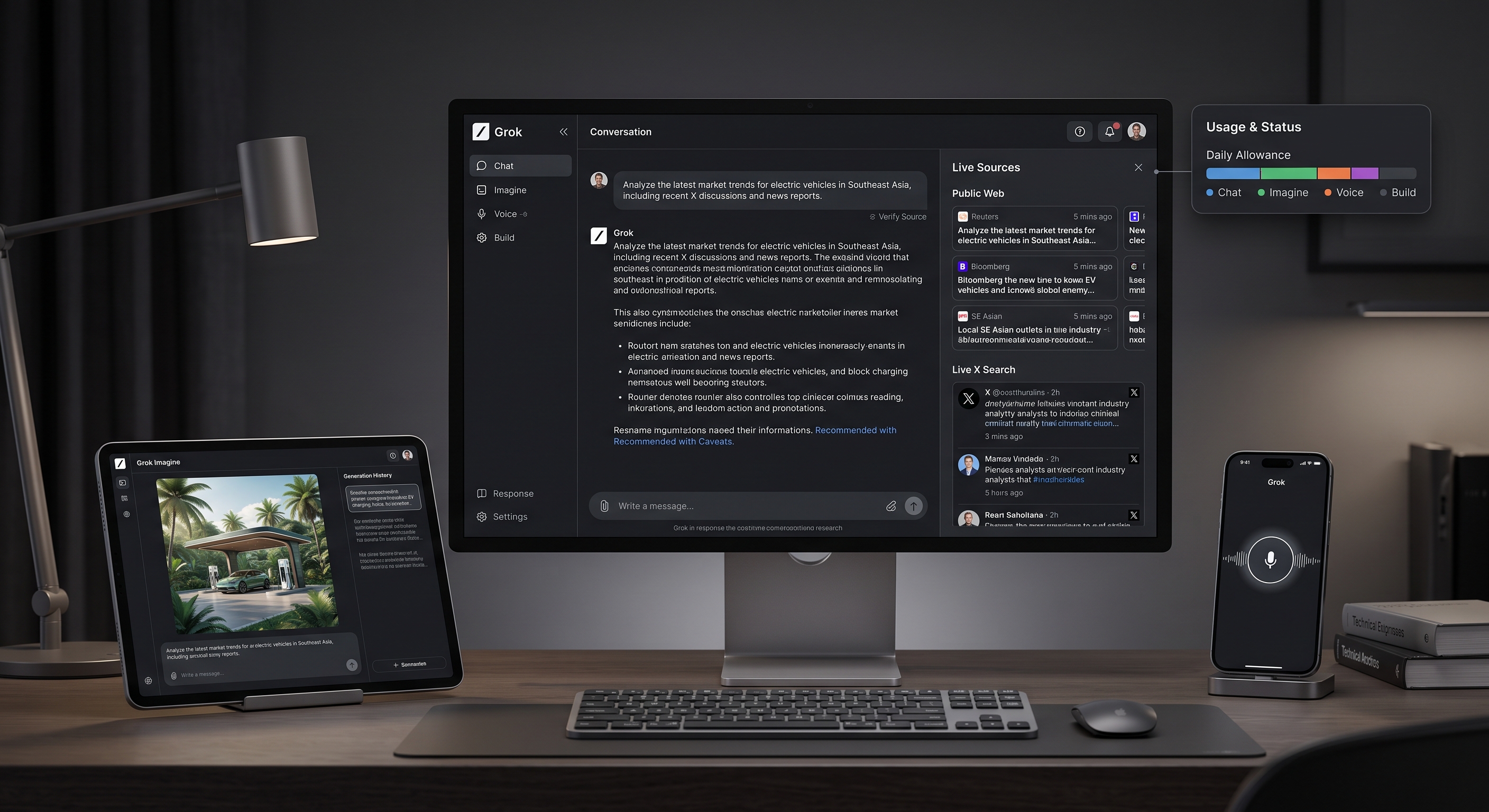
The official product page says Grok searches the web and X live and can return citations from primary sources. That is the clearest reason to choose it over a general assistant that relies mainly on its training data. It matters for news monitoring, market research, trend checks and questions where the answer can change during the day.
Live retrieval is not the same as reliable judgment. A cited answer can still select weak sources, misunderstand a post or miss context. Use Grok as a fast research layer and check important claims in the linked sources before using them in a client deliverable or published article.
Files, voice and media generation
Grok supports common documents, spreadsheets, images, audio, video, code and data files. The help page lists a typical 150 MB per-file limit and says platform or subscription limits can vary. Grok Imagine handles image and video generation, while voice supports hands-free conversations. This combination is useful for a creator or consultant who wants to move from a source file to a draft, visual concept or spoken review without switching apps.
The cost is usage uncertainty. xAI says different products consume different amounts of compute. A chat message uses less of the weekly allowance than high-quality video or a long coding task. If you buy Grok mainly for media generation, watch the usage breakdown instead of assuming that a paid plan means unlimited creation.
Multi-agent research, coding and Canvas
The current Grok page highlights multi-agent work, where several agents handle parts of a difficult question before their results are merged. It also lists code generation, reasoning, memory across chats, custom instructions and Canvas for long-form editing. These features can reduce the number of separate tools a solo user needs for research, drafting and technical work.
They add judgment rather than remove it. Multi-agent output can still be wrong, code still needs tests and security review, and memory can be a privacy concern when the assistant retains preferences or conversation context. Use these features to speed up a reviewable workflow, not as a replacement for a human check.
How Grok works in practice
A normal workflow starts at grok.com or in the mobile app. You ask a question, choose a search or reasoning mode when needed, attach files, refine the result and continue in the same thread. The product page also supports follow-up work across writing, code and media. The useful pattern is iterative: ask for a first answer, ask it to identify assumptions and sources, then edit the result before sharing it.
- Start with one recurring task such as weekly research, document summaries or draft creation.
- Use the source links and ask for uncertainty when the answer may affect money, health, legal work or a client decision.
- Check the Usage view when you use Chat, Imagine, Voice and Build in the same week.
- Keep private or regulated content out of a personal workspace until your organization has approved the account and data controls.
Ease of use and setup
The Free plan and familiar web and mobile entry points make Grok easy to try. Sign-in can use email or linked accounts, and synced history is convenient when moving between devices. Setup becomes more involved when you add connectors. xAI’s docs describe OAuth permissions for email, calendar and Drive, and Business admins must provision connectors before team members can use them. That is a reasonable control, but it is still administration work.
Grok pricing and plans
The current public pricing page checked 2026-08-23 lists Free at $0 per month, SuperGrok at $30 per month and SuperGrok Plus at $100 per month. The Business page lists $30 per user per month, while Enterprise is custom. The pricing page also shows SuperGrok Lite and SuperGrok Heavy in its comparison, but it does not display a public price for either plan in the page content I could verify. Do not treat older stored price points or a search snippet as current checkout pricing.
Grok public plans checked 2026-08-23| Plan | Public price | Main use case | Important conditions |
| Free | $0/month | Try chat, search, voice, files and selected creation features | Free limits apply. The official page does not present it as unlimited. |
| SuperGrok | $30/month | Regular individual use across chat, search, files, coding and media | Higher limits across features. It draws from one shared weekly usage allowance. |
| SuperGrok Plus | $100/month | Heavy individual use and higher-capacity creation | Higher usage, priority access and 1080p video are listed. It is a specialist price. |
| Business | $30/user/month | Small and medium teams with seats, billing and admin controls | Enterprise controls and custom terms are separate. Confirm data and connector requirements. |
| Enterprise | Custom | Large organizations with governance or scale needs | SSO, SCIM, advanced audit, custom retention, CMEK and dedicated data plane are listed as higher-tier controls. |
Free plan and trial
Grok has a genuine Free plan, so you can test the workflow without committing to a monthly subscription. The trade-off is that the free tier has lower or limited access to some features. The help documentation also describes weekly allowances for paid users and extra credits after a limit. This makes Free useful for product fit, but not enough to predict the exact capacity of a paid workflow unless you use the same products and task pattern.
Important limits and upgrade triggers
- You use a shared weekly pool: Chat, Imagine, Voice, Build and other products draw from the same paid allowance.
- Heavy tasks cost more of that pool: high-quality video and long coding work use more compute than a short chat.
- You hit the pool: paid features can pause until reset, or you can buy extra usage credits or upgrade.
- You need a plan price that is not public: Lite and Heavy are shown in the comparison but their current public price is unclear.
- You need stable business ownership: move from personal subscriptions to Business or Enterprise rather than sharing accounts.
- You need API access: use the separate xAI API with its own billing and limits.
The important budgeting question is not only “How much is the plan?” It is “Which Grok products will consume the weekly allowance, and what happens when I reach it?” xAI says top-ups can continue paid use, but extra credits are priced at standard rates and can cost more per action than included usage.
Integrations and compatibility
The current connector documentation lists built-in connections for Google Drive, Gmail, Google Calendar, OneDrive, Outlook, Microsoft Teams, SharePoint and Salesforce. It also describes a catalog that includes services such as Box, Canva, Gamma, GitHub, Linear, Notion and Vercel, plus custom MCP connectors. This is more useful than a simple “integrates with” badge because Grok can search, read or update data depending on the connector and granted permissions.
Permissions are the boundary. Gmail can be read-only or can gain draft, label and send capabilities when the relevant permissions are enabled. Business admins provision connectors for their organization. A custom MCP server must be reachable over the public internet. Treat every connector as a real data-access integration with approval, scope and revocation steps, not as a harmless convenience setting.
Security, privacy and compliance
xAI’s current Business pages advertise SOC 2 Type I and II, HIPAA, GDPR and CCPA, plus role-based access, no training, team management and connectors. The Enterprise comparison adds SSO, SCIM, advanced audit and security controls, custom retention, customer-managed encryption keys and a dedicated data plane. These are useful signs for a business review, but a marketing page is not a complete approval package. Ask for the current report, DPA, contract terms and exact plan scope.
The consumer privacy policy creates an important difference. It says xAI may collect prompts, files, images, audio, video, technical data, location data and conversation history, and may use User Content to provide, improve and train its services. The Privacy Portal provides a training opt-out. That means a personal Grok account should not be treated as “no training” by default. Connector pages separately say that connected Google data is not used for training and is not stored after the request. Those claims apply to the connector workflow, not automatically to every consumer prompt or upload.
xAI also publishes a subprocessor list that includes US cloud, support, payment, monitoring and related providers. The list is useful for due diligence, but it does not by itself answer every data residency or retention question. A regulated buyer should match the exact workspace, geography, DPA, retention setting and Enterprise controls to its obligations. If that review is not complete, do not use personal Grok for sensitive client data.
Support and documentation
Grok’s help documentation is unusually useful for a fast-moving AI product. It covers plan billing, limits, top-ups, file types, account issues, connectors, product changes and troubleshooting. The FAQ says users can report bugs through the product and include account, platform and receipt details, but it does not promise a response time. Business and Enterprise pages add priority or dedicated support language at higher tiers. Expect self-service support unless your contract says otherwise.
Main strengths
- Live web and X search are a real differentiator for current research and trend monitoring.
- Free access makes it easy to test the product before paying.
- Chat, files, voice, code, image and video generation cover a wide range of solo workflows.
- Connectors and Business workspaces give teams a path beyond personal accounts.
- The public help material explains changing limits, file boundaries and billing behavior in practical detail.
Main weaknesses
- The shared weekly pool makes heavy mixed-media use harder to budget than a simple unlimited plan.
- Extra usage credits can keep work moving but may cost more per action than included usage.
- Lite and Heavy appear in the public comparison without a clear public price on the page checked.
- Consumer privacy settings and Business or Enterprise privacy claims are easy to confuse.
- The broad feature set increases the need for source checking, prompt discipline, code review and permission management.
Grok alternatives
ChatGPT is the broader alternative if you want a large ecosystem of custom assistants, files, tools and business plans outside an X-first context. Claude is worth comparing for long-form writing, careful document work and a less media-focused workflow. Gemini is a strong option when your work already lives in Gmail, Docs, Drive and other Google services. Perplexity is more focused on search-led answers. The best choice depends on where your data lives, how much current social context matters and whether you need a consumer assistant, managed workspace or API.
How to decide
Try Free with one real task before paying. If live search and X context are the main value, measure whether you use them often enough to justify SuperGrok. If you are a creator, compare the cost of your actual video and image workload with the weekly allowance before considering Plus. If you are a team, set up Business with organization-owned seats and test a connector on non-sensitive data. If you are building software, skip the subscription decision and price the API separately.
Final verdict: is Grok worth it?
Grok is worth trying and can be worth paying for when live web and X search, multimodal creation and flexible connected work are central to your week. It earns Recommended with caveats because its capability range is strong and Free lowers the risk of testing it. The decision is not universal. Casual users may not need the $30 plan, heavy creators may need to budget for Plus or top-ups, and regulated organizations need a formal Business or Enterprise review. Start with Free, measure your usage, and upgrade only when the workflow proves the cost.