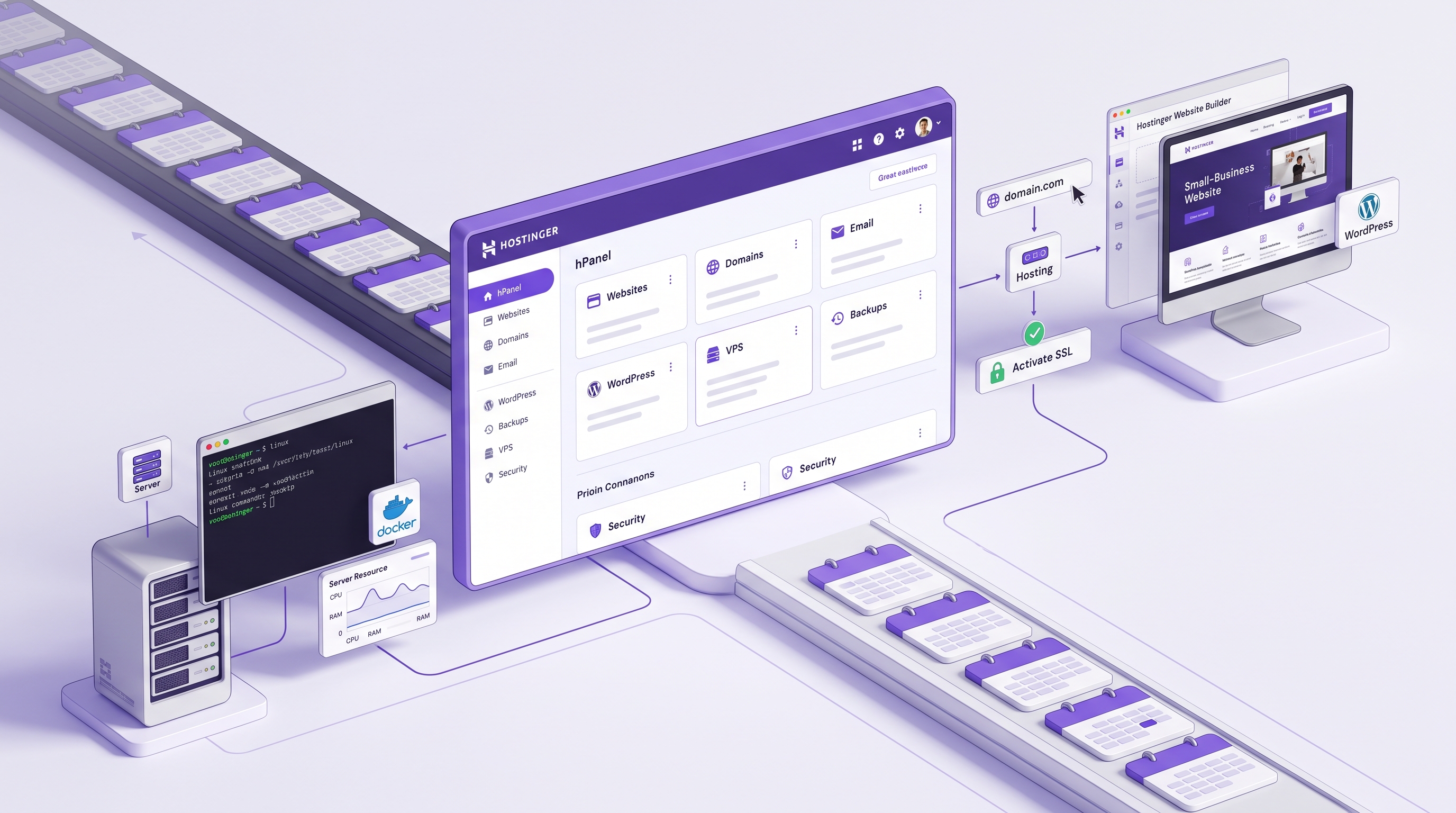
Hostinger is a budget-focused hosting provider for websites, WordPress, cloud hosting, domains, email, and self-managed VPS servers. Its main appeal is easy setup at a low promotional price. The main catch is that the headline web-hosting rates require a 48-month term paid upfront, and renewal prices are much higher. This research-based review explains where Hostinger fits, what the plans really cost, and when a more managed or more flexible host is a better choice.

Product profile
Hostinger
See Hostinger’s BettrList score, current plan summary, product facts, and official link.
BettrList may earn a commission from some outbound product links. This does not affect the product score, recommendation, pros, cons, or alternatives in this review.
Hostinger review: quick verdict
Hostinger is recommended with caveats. It is a practical fit for a beginner launching a small site, a creator managing a few websites, or a budget-conscious business that wants a simple dashboard and common hosting tools. Premium is enough for a small portfolio or one to three sites. Unlimited is the more sensible shared-hosting starting point when daily backups, more sites, and more storage matter. Cloud or VPS plans make sense when the workload needs more resources, but VPS is self-managed. The decision is not universal because the long upfront term, higher renewal rate, chat-only support, and resource limits can matter more than the opening price.
- Best reason to choose Hostinger: a clear hPanel dashboard, common site-building tools, and low introductory prices in one account.
- Main weakness: the cheapest price is tied to a long prepaid term, and renewal pricing changes the long-term cost calculation.
- Best starting point: Premium for a small site, Unlimited for several sites or daily backups, and Cloud or VPS only when the extra resources justify more complexity.
- What to check first: your storage, site count, backup needs, renewal budget, support expectations, and whether you need managed hosting or root access.
What is Hostinger?
Hostinger sells several hosting models under one account. Shared web hosting is the easiest entry point for WordPress, small business websites, portfolios, blogs, and simple ecommerce sites. Cloud hosting adds more dedicated resources for busier projects. KVM VPS provides full root access and more control, but the customer manages the server. Hostinger also offers a website builder, domains, email, WordPress tools, AI-assisted site features, and developer automation through its API.
Shared and cloud plans remove much of the server work, but owners still need to update WordPress, plugins, themes, and application code. VPS is different. It gives more control, but Hostinger describes it as self-managed, supported by guides, templates, an AI assistant, and live chat.
Who is Hostinger designed for?
Hostinger is designed for people who want to launch and manage websites without building a server stack from scratch. A solo consultant can host a brochure site and email. A creator can run a portfolio, blog, or small store. A small agency can put several client sites under one shared plan if the resource limits and account structure fit. A technical user can move to a VPS when a project needs root access, Docker, a custom operating system, or more predictable server resources.
It is less suitable for a buyer who needs phone support, strict enterprise procurement, guaranteed dedicated resources on a shared plan, or a fully managed server operations service. It is also a poor fit for a team that will not monitor renewals, backups, storage, and application updates. The low entry price is useful, but it does not turn hosting into a set-and-forget service.
Hostinger features that matter in practice
hPanel and guided setup
hPanel is Hostinger’s central control panel for hosting, domains, email, VPS, billing, DNS, files, databases, and site tools. This matters because most beginner hosting problems are not about raw server power. They are about finding the right setting. A unified dashboard can reduce the number of separate tools a site owner has to learn. The trade-off is that hPanel is Hostinger’s own interface. A person who already knows cPanel may need to learn a different workflow, and a team moving away later should document its DNS, email, cron, and application settings.
WordPress, site builder, and application installs
Hostinger supports WordPress, its drag-and-drop builder, custom PHP and HTML sites, Node.js on supported plans, and VPS. Auto Installer covers WordPress, Joomla, Drupal, and other applications. The practical benefit is a shorter path to a working site. The limitation is that each path has different migration, backup, and compatibility rules. A proprietary builder is less portable than a file-based site, so choose it with future migration in mind.
Storage, CDN, LiteSpeed, and server locations
Hostinger’s current web plans use SSD or NVMe storage depending on the plan, include a CDN, and use LiteSpeed technology for managed web hosting. Hostinger also lists data centers in several regions. These features can improve the starting setup for a small site because the owner does not need to assemble a CDN and server cache from scratch. They do not guarantee fast pages. Theme quality, image size, database queries, third-party scripts, and application code still decide much of the final experience.
Backups and migration
The current web-hosting pricing page shows weekly backups on Premium, daily backups and restore on Unlimited, and daily plus on-demand backups on Cloud Startup. Hostinger’s help material also explains that backup coverage varies by service and plan. The useful lesson is to check the exact plan rather than assuming every backup feature is included everywhere. Hostinger offers free external website migration in eligible cases, but the migration documentation excludes email migration, does not support WordPress multisite migration, and says internal moves can require a paid tool or manual work.
VPS control and AI-assisted administration
Hostinger’s KVM VPS plans include full root access, AMD EPYC processors, NVMe storage, weekly backups, firewall management, a public API, and an AI web terminal. KVM 2 currently lists two virtual CPU cores, 8 GB of RAM, 100 GB of NVMe storage, and 8 TB of bandwidth. This is useful for a developer running Docker, n8n, a custom application, or a server that has outgrown shared hosting. The trade-off is operational ownership. You must secure the server, update packages, configure the application, monitor it, and test recovery. The AI assistant may reduce command-line friction, but it does not replace an operator who understands the result of each change.
API, SDKs, and integrations
Hostinger publishes an API with SDKs and tools for TypeScript, Python, PHP, Terraform, Ansible, n8n, CLI, and MCP integrations. It can automate hosting operations, but API tokens have the owner’s permissions and need careful storage. Check rate limits, token expiry, and beta status before building around it.
How Hostinger works in practice
Choose a hosting model, connect a domain, install a supported application, enable SSL, and set up email and DNS. Then create a backup, record the renewal date, and use account access controls instead of sharing the main login. For a migration, keep the old host online until DNS, forms, checkout, email, redirects, analytics, and backups are tested.
- Start with one real site and confirm the dashboard matches the owner’s comfort level before moving several client sites.
- Write down the plan term, the amount paid upfront, the renewal price, and which domain or mailbox benefits expire after the first year.
- Test a restore or at least confirm what the backup includes. Website files and databases are not the same as email data.
- Move to Cloud or VPS only when a specific storage, compute, traffic, or control requirement is blocking the current plan.
Ease of use and setup
Hostinger’s strongest editorial advantage is the path from purchase to a working site. hPanel puts the main account and site controls in one place, and the installer and builder paths are aimed at people who do not want to configure a server manually. The setup still becomes more involved when you use custom code, DNS records, mailboxes, cron jobs, staging, or a VPS. The interface can make the first step easy, but it cannot remove the decisions around backups, access, updates, and recovery.
Hostinger pricing and plans
The prices below are the US web-hosting and VPS prices checked on August 16, 2026. The web-hosting pricing page presents the headline rates for a 48-month term, paid upfront. Hostinger also states that shorter subscription periods are available, but the monthly equivalent will change. Renewal prices are listed separately and are the more useful numbers for estimating the second term.
Hostinger plans checked August 16, 2026| Plan | Intro rate | Upfront term | Renewal rate | Main limits and use |
| Premium | $2.99/mo | $143.52 for 48 months | $10.99/mo | 3 websites, 20GB SSD, weekly backups, CDN, free domain for 1 year |
| Unlimited | $3.79/mo | $181.92 for 48 months | $16.99/mo | Unlimited websites, 50GB NVMe, daily backups and restore, CDN, mailboxes |
| Cloud Startup | $7.99/mo | $383.52 for 48 months | $25.99/mo | Unlimited websites, 100GB NVMe, daily and on-demand backups, dedicated cloud resources |
| KVM 2 VPS | $8.79/mo | Paid upfront for 2 years | $14.99/mo | 2 vCPU, 8GB RAM, 100GB NVMe, 8TB bandwidth, full root access, self-managed |
The $2.99, $3.79, and $7.99 web-hosting figures are monthly equivalents of a 48-month purchase, not normal month-to-month prices. The page also shows higher renewal prices and conditions for free domains and mailboxes. Treat renewal and add-ons as part of the real price.
Free plan and money-back guarantee
Hostinger does not offer a permanent free hosting plan. It offers a 30-day money-back guarantee for eligible hosting purchases, including web, cloud, Agency, and KVM VPS plans, subject to the published refund rules and payment-method exceptions. That is a trial window with a refund process, not a free tier. Before relying on it, check the current refund policy and confirm that your intended service, payment method, domain, or add-on is eligible.
Important limits and upgrade triggers
- The promotional term ends: renewal can be several times the introductory monthly equivalent, so budget for the next term before committing.
- You need more websites or storage: Premium is capped at three websites and 20GB, while Unlimited and Cloud Startup add capacity and different backup coverage.
- You need recovery points or email recovery: plan-level website backups do not mean every email, builder site, or custom service is included in the same way.
- The site needs dedicated resources: Cloud adds more predictable resources, while VPS adds root access but also shifts security and operations work to the customer.
- You need phone support or enterprise controls: Hostinger’s support model is online chat and documentation, and the public security material does not make the service a general HIPAA-compliant environment.
Before buying, write down the full upfront payment, renewal price, term, storage limit, backup frequency, mailbox condition, and refund rules. The headline monthly figure alone is not enough to compare hosting plans.
Integrations and compatibility
Hostinger fits common WordPress, WooCommerce, PHP, HTML, Node.js, DNS, email, domain, and VPS workflows. Auto Installer and the API ecosystem reduce setup for common tools. It is less compelling if your workflow depends on a specific panel, unrestricted server modules, or a platform outside Hostinger’s migration scope.
Security, privacy, and compliance
Hostinger publishes security measures that include monitoring, firewalls, anti-malware protection, vulnerability scanning, 2FA on applicable systems, backups, and secure development practices. Its Trust Center states that Hostinger is ISO/IEC 27001:2022 certified and highlights GDPR, WAF, DDoS protection, and security documentation. These are useful signs for a small business buyer. They do not make every website secure by default. The owner still controls passwords, collaborators, CMS updates, plugins, application code, data collection, and recovery testing.
The public security guidance also says Hostinger’s hosting services are not intended to provide a HIPAA-compliant environment. A regulated buyer should therefore treat the Trust Center as an input to a security review, not as automatic approval. Check the current privacy policy, data processing terms, data center choice, retention, subprocessors, access controls, and contract requirements before putting regulated or sensitive data on the service.
Support and documentation
Hostinger provides 24/7 live chat, an AI assistant, tutorials, a knowledge base, and videos. That works well for common setup and account problems, especially when screenshots and error messages help explain an issue. Hostinger does not offer phone support, and VPS customers still own server configuration and application troubleshooting.
Hostinger pros and cons
Main strengths
- The hPanel dashboard and guided setup reduce the first-step friction for beginners.
- The shared plans combine hosting, SSL, CDN, domain eligibility, backups, and common site tools in one account.
- Premium and Unlimited provide a low-cost path for small sites and small portfolios when the long term is affordable.
- The API, SDKs, Terraform, n8n, CLI, and MCP tooling give technical users more automation options than a basic shared host usually exposes.
- Free external migrations are useful for eligible sites, and the support library is broad and practical.
Main weaknesses
- The advertised web-hosting price requires a large upfront payment and renewal is much higher.
- Premium’s three-site and 20GB limits can become restrictive for agencies, media-heavy sites, or several client projects.
- Support is online chat only, so it is a poor fit for an organization that requires phone escalation.
- VPS gives control but is self-managed, which creates real security, update, monitoring, and recovery work.
- Migration assistance has scope limits. Email, WordPress multisite, internal moves, and proprietary builders may need separate work or cost.
Best use cases and poor-fit use cases
Hostinger is most convincing for:
- A solo consultant launching a brochure site, portfolio, blog, or simple lead-generation website on a limited budget.
- A creator or small brand running up to three sites and willing to pay for the 48-month Premium term.
- A small agency that needs several websites, centralized billing, daily backups, and an upgrade path to Cloud hosting.
- A developer who wants an inexpensive, self-managed VPS with root access and API automation for side projects.
Hostinger is a poor fit for:
- A hobby site owner who cannot justify paying for a long term upfront or who expects a permanent free plan.
- A business that needs phone support, contractual enterprise controls, or a dedicated account support model.
- A regulated organization that needs an approved HIPAA environment or exact compliance terms before purchase.
- A technical team that wants root access without owning patching, hardening, monitoring, and recovery for the server.
Hostinger alternatives
Choose Kinsta when the main WordPress site is important enough to justify a more managed and more expensive hosting model. Choose Cloudways when you want a managed layer over cloud providers and are willing to compare the total service price. Choose DigitalOcean or Vultr when you want infrastructure control and have someone who can own Linux operations, backups, security, and deployments. Choose Wix or Squarespace when the priority is an all-in-one site builder rather than a conventional hosting account. These alternatives solve different problems. The right comparison is about control, support, portability, and total operating work, not only the first monthly figure.
Decision scenarios
These scenarios use the published plans and documentation. They are editorial fit judgments, not results from a private Hostinger account test.
Final verdict
Hostinger earns a recommendation with caveats. It is a sensible low-cost starting point for common websites, especially when hPanel, WordPress setup, backups, CDN, and chat support cover the owner’s needs. The value is strongest when the buyer can afford the upfront term and has a clear renewal budget. The value weakens when the site needs more resources, stricter support, exact compliance commitments, or server administration that nobody owns.
Choose Premium for a small site or portfolio, Unlimited when daily backups and several sites matter, and Cloud when a real resource need justifies the price. Choose VPS only if someone can manage the server. Start with one non-critical site, verify the dashboard and support workflow, record the renewal date, and test your backup and migration assumptions before moving important projects. That is the safest way to decide whether Hostinger’s low entry price remains good value for your situation.