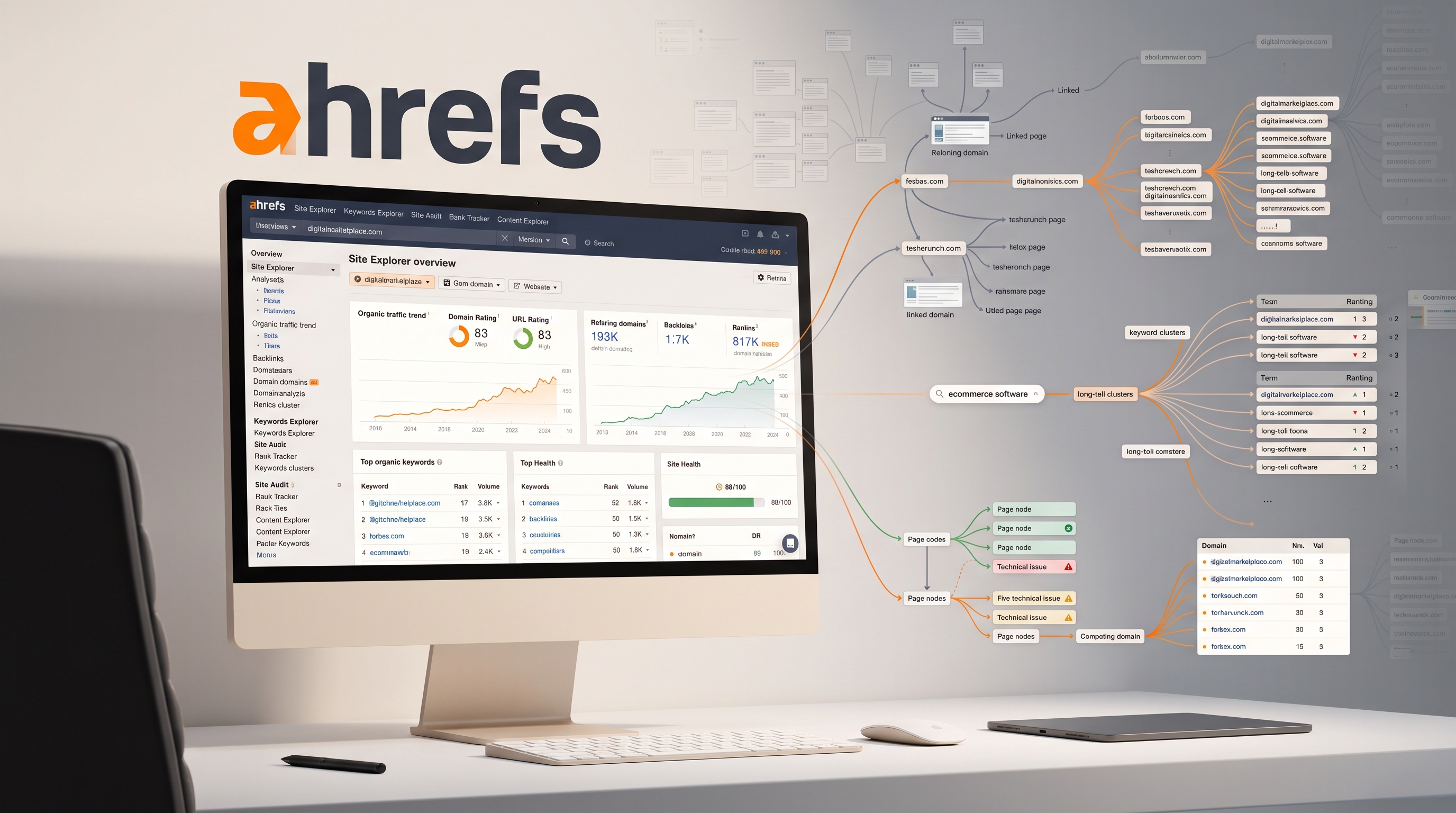
Ahrefs is a serious SEO and marketing research platform built around competitor analysis, keyword data, backlinks, technical audits, rank tracking, content research, and newer AI-visibility tools. This review is research-based. It uses current public Ahrefs pricing, Help Center, Academy, API, security, privacy, and legal material checked August 23, 2026. No private Ahrefs account, paid plan, or workflow was used for hands-on testing.

Product profile
Ahrefs
See Ahrefs’ BettrList score, plan snapshot, product facts, and official link.
Research-based review: the article below separates published Ahrefs facts from BettrList judgment. It does not claim account testing, screenshots, benchmarks, or first-hand workflow results.
Ahrefs review: quick verdict
Ahrefs is recommended with caveats. It is a strong fit for SEO professionals, agencies, content marketers, and in-house teams that need deep competitor, keyword, backlink, technical, and ranking data in one place. The free tier is genuinely useful for owners of verified sites, and Starter gives beginners a cheaper way to try paid research. The main problem is cost and usage design. Lite is already a substantial monthly commitment, credit-based plans make exploratory work more deliberate, and important reporting, historical data, API, and team features sit on higher tiers. Ahrefs is worth it when SEO research is a recurring operating function. It is not worth the price for a small team that only wants occasional keyword ideas or a simple rank check.
- Choose Ahrefs when competitor research, backlinks, technical audits, and rank tracking all matter every month.
- Start with Ahrefs Free for one verified site, Starter for limited paid research, and Lite only when the workflow is regular enough to justify the jump.
- Move to Standard or Advanced when Content Explorer, batch analysis, larger exports, deeper history, or fair-use research becomes a weekly need.
- Treat Enterprise as a governance and procurement purchase, not a simple feature upgrade.
What is Ahrefs?
Ahrefs is a web-based platform for improving visibility in search, AI answers, and related discovery channels. Its core tools cover Site Explorer for competitor and backlink research, Keywords Explorer for keyword opportunities, Site Audit for technical and on-page problems, Rank Tracker for positions by location and device, and Content Explorer for finding high-performing pages and link prospects. Ahrefs also lists Brand Radar for AI visibility, Web Analytics, social publishing, API access, reporting, and other supporting tools.
The product is best understood as a research workbench, not an automated SEO strategy. It can show where competitors get traffic, which pages attract links, what topics have demand, and which technical issues need attention. It cannot decide whether a business should pursue a keyword, whether a page is genuinely useful, or whether a link opportunity is worth the outreach cost. Those remain editorial and commercial decisions.
Who is Ahrefs designed for?
Ahrefs is designed for people who make repeated search and content decisions. A freelance SEO can use it to audit client sites, compare competitors, track rankings, and prepare reports. A content marketer can use it to find topics, inspect search results, compare content gaps, and prioritize updates. An in-house marketing team can combine technical audits, rank tracking, backlink monitoring, and AI visibility prompts across a larger site portfolio. An agency can use the shared project, export, reporting, and API limits to standardize client work.
The fit is weaker for a creator with one small site and no regular research habit, a business that only needs first-party performance data from Google Search Console, or a team that wants a simple checklist rather than a large data platform. Ahrefs rewards users who know what question they are investigating. It is less forgiving when a buyer pays for breadth but has no process for turning reports into action.
Ahrefs features that matter in practice
Site Explorer: competitor and backlink research
Site Explorer is the feature that makes Ahrefs more than a site-audit tool. It can expose a domain’s organic keywords, estimated traffic, top pages, paid search pages, backlink profile, referring domains, anchors, and other site-level patterns. This matters when you need to understand how a competitor earns visibility rather than only whether your own pages are indexed. The limitation is access. Ahrefs Free is restricted to websites you can verify, while paid plans unlock research on unverified competitor domains. Starter and Lite also use credits for many report and filter actions, so broad exploration can consume the monthly allowance faster than a focused question.
Keywords Explorer: finding realistic opportunities
Keywords Explorer helps turn a broad topic into keyword ideas with search volume, difficulty, traffic potential, SERP context, and related terms. It is useful when a marketer needs to decide whether a topic is worth producing before spending time on a brief or article. Standard and higher plans add features such as AI suggestions, search intent, keyword clusters, translations, and SERP updates. The practical judgment is that Ahrefs data improves prioritization, but the metrics are estimates. A low difficulty score does not guarantee that a small site can rank, and a high-volume term may still be a poor business choice.
Site Audit and Rank Tracker: ongoing measurement
Site Audit crawls a website for technical and on-page issues, including broken links, missing tags, duplicate content, and other problems. Ahrefs says its audit covers more than 170 issue types. Rank Tracker monitors chosen keywords by location and device on a weekly schedule. Together, they create a repeatable maintenance loop: crawl the site, fix the highest-impact problems, track target queries, and review changes over time. The important limits are crawl credits, project size, and tracked keyword capacity. Ahrefs Free gives 5,000 crawl credits per month for each verified project, while the listed paid tiers step up from 100,000 to 1.5 million monthly crawl credits and from 750 to 5,000 tracked keywords.
Content Explorer, Brand Radar, and AI features
Content Explorer helps find pages that perform well in a topic and potential link-building opportunities. The current plan comparison places it with Standard and higher, along with batch analysis and deeper Site Explorer reports. Brand Radar tracks selected AI prompts and appears in the paid plan comparison with daily updates and plan-specific prompt limits. Ahrefs also documents AI Content Helper and other AI features, while Content Kit and Project Boost add-ons can create separate costs. These tools are useful when the team has an existing content or visibility process. They are less useful when AI reporting becomes another dashboard with no owner, review routine, or measurable decision attached.
How Ahrefs works in practice
A practical Ahrefs workflow starts with a project and a question. For a client site, that may be “which technical issues block important pages?” For a content team, it may be “which topics do competitors win that we do not cover?” For a link-building campaign, it may be “which pages attract links from sites relevant to our audience?” You choose the relevant tool, load a report, filter or compare the data, and then export or turn the findings into a brief, task, report, or update plan. This is the platform’s strength: it shortens research time across several SEO jobs. Its weakness is that the user must manage credits, project scope, exports, and interpretation while doing the work.
Ease of use and setup
Ahrefs provides a clear learning path through the Academy and Help Center. The main tools have familiar purposes, and the public documentation explains limits in more detail than many software pricing pages. The setup is still not trivial. A useful workspace needs verified projects, tracked keywords, competitors, locations, exports, and recurring audit decisions. New users can also over-read metrics because the platform produces more data than a small team can act on. The best approach is to define three repeatable questions first, create only the projects you will use, and review usage before the first billing cycle ends.
Ahrefs pricing and plans
The prices below use the US list prices visible in the official pricing view checked August 23, 2026. Ahrefs shows annual billing as a way to save up to about 17 percent. Starter is monthly only. Lite and Starter are credit-based, while current Standard, Advanced, and Enterprise plans use fair-use access for normal research but still have separate project, export, rank tracking, crawl, API, and report limits. Additional active users are billed separately on the paid tiers.
Ahrefs plans checked August 23, 2026| Plan | Listed price and billing | Best use | Important limits or upgrade triggers |
| Ahrefs Free | $0; ongoing access after site verification | Owners auditing and monitoring their own sites | Verified sites only for key reports, 5,000 crawl credits per verified project, limited rows, no competitor research |
| Starter | $29/mo; monthly renewal only | Beginners who need paid keyword and competitor research | 200 credits, 1 unverified project, 50 tracked keywords, 250-row reports, no additional users or credits |
| Lite | $129/mo at the listed US rate; annual billing available | Small businesses and recurring solo SEO work | 5 unverified projects, 750 keywords, 100,000 crawl credits, 6 months of history, credit-based research |
| Standard | $249/mo at the listed US rate; annual billing available | Freelance SEOs, consultants, and agencies | 20 projects, 2,000 keywords, 500,000 crawl credits, 2 years of history, 1.5M export rows |
| Advanced | $449/mo at the listed US rate; annual billing available | Lean in-house teams with larger data needs | 50 projects, 5,000 keywords, 1.5M crawl credits, 5 years of history, Looker Studio connectors |
| Enterprise | $1,499/mo listed; annual commitment required | Organizations needing SSO, audit logs, custom limits, and uncapped API access | Custom terms, procurement review, and no public SOC 2 certification claim |
Free plan, trials, and upgrade triggers
Ahrefs Free is more useful than a token trial. A verified owner can use Site Explorer for limited backlink and organic-search reports, run Site Audit with 5,000 crawl credits per verified project, use Web Analytics up to its published allowance, and access selected free tools. The important boundary is ownership. Free access is designed for your own verified websites, not for unrestricted competitor research. Ahrefs says it does not offer free trials. Starter is the low-cost paid route, but its 200 monthly credits and small report limits make it a deliberate research plan, not a miniature version of Lite.
The first upgrade trigger is usually access to competitor data. The next is recurring volume: more unverified projects, tracked keywords, crawl credits, rows, exports, and historical data. Standard is the meaningful step for teams that need Content Explorer, batch analysis, deeper history, and fair-use access for normal research. Advanced adds larger limits and Looker Studio. Enterprise adds SSO, access management, audit logs, unlimited history, personalized limits, and uncapped API access. Add-ons such as Content Kit, Report Builder, Project Boost, and custom prompt packages can raise the total cost beyond the base subscription.
Integrations and compatibility
Ahrefs supports API v3 through direct API access, MCP Server, and Ahrefs Connect. The current API documentation lists Lite as the starting tier, with 100,000 API integration units per month and 100 rows per request, rising through Standard and Advanced to Enterprise’s higher limits. Ahrefs also provides official Looker Studio connectors for Site Explorer, Site Audit, Rank Tracker, and Brand Radar, but the Help Center says those connectors require Advanced or higher. The product can therefore fit a reporting stack, but teams should confirm the plan gate before designing around an integration.
The main product is web-based and the existing BettrList Product record lists Web and Chrome Extension support. Ahrefs also provides a browser toolbar and standalone free tools. The useful compatibility question is not just whether a platform is supported. It is whether your team can move data into the next step: a report, content brief, task system, dashboard, or client update. API, exports, and Looker Studio help with that, but higher limits and higher plans are part of the same decision.
Security, privacy, and compliance
Ahrefs publishes security measures covering TLS, encryption at rest and in transit, environment separation, access controls, logging, backups, monitoring, and incident response. It also publishes a Data Processing Addendum that references GDPR and PDPA obligations and includes pre-signed EU Standard Contractual Clauses for relevant transfers. A separate Cure53 document provides a summary of a 2024 external security assessment covering Ahrefs web, API, and infrastructure surfaces. These are useful documents for an initial vendor review.
The limitation matters for regulated buyers. Ahrefs’ security page says its systems have not been certified, and the current FAQ says SOC 2 certification is in progress. That means a buyer should not describe Ahrefs as SOC 2 certified based on the public material checked here. Review the DPA, privacy policy, subprocessors, retention, account controls, SSO scope, audit-log availability, and the vendor’s current answers for your data before approval. The public evidence supports a documented security program, not automatic compliance with every customer policy.
Support and documentation
Ahrefs has a strong self-serve support layer. The Help Center covers plan limits, credits, projects, rank tracking, API, integrations, and common account questions. The Academy adds guided courses and lessons for the core tools. Ahrefs also lists live chat and email support. That is enough for many freelancers and small teams. A larger buyer should still ask what response times, onboarding, account help, and escalation terms apply to the proposed plan, because public education material is not the same as a contractual service level.
Main strengths
- Deep competitor, backlink, keyword, technical audit, and ranking research in one established platform.
- A real free tier for verified site owners, plus a $29 monthly Starter plan for cautious paid adoption.
- Clear public documentation for credits, project limits, exports, API usage, and plan differences.
- Strong workflow coverage for agencies and content teams that need repeatable research and reporting.
- Published security, privacy, DPA, and external assessment material gives procurement a concrete starting point.
Main weaknesses
- Lite and higher plans are expensive for a single small site or occasional keyword research.
- Starter and Lite credits make broad exploratory research a budgeting and workflow concern.
- Important features such as Content Explorer, batch analysis, Looker Studio, deeper history, and large exports require higher tiers.
- Additional active users and add-ons can make the real team cost much higher than the headline plan price.
- The public security material is useful but does not support calling Ahrefs SOC 2 certified today.
Ahrefs alternatives
Choose Google Search Console when you mainly need first-party performance, indexing, and query data for your own site. Consider Semrush when you want a similarly broad SEO and marketing suite and prefer its specific workflow or pricing structure. Consider SE Ranking or a focused rank-tracking tool when a smaller team values lower cost and simpler monitoring over Ahrefs’ depth of backlink and competitor data. No alternative is automatically better. The right choice depends on whether your main problem is research depth, reporting, rank tracking, or cost control.
Best use cases and poor-fit use cases
Ahrefs is strongest for a freelance SEO managing recurring client work, a small agency producing repeatable reports, a content team prioritizing topics and updates, and an in-house marketing team tracking several websites. It is also useful for a site owner who wants a technically detailed audit and backlink view without paying at the start. The poor-fit cases are equally important: a team that only needs occasional keyword ideas, a creator with no plan to use the data, or a procurement group that requires current SOC 2 certification before approving a vendor.
Decision scenarios
The most reliable way to decide is to price the workflow you will actually run. The scenarios below separate a free site-owner use case from the paid situations where Ahrefs’ limits and plan gates start to matter.
- One verified site and a low budget: start with Ahrefs Free and upgrade only when competitor research becomes regular.
- A freelance SEO with several clients: compare Lite and Standard using real project, keyword, export, and user counts.
- A three-person agency: include two extra active-user charges and confirm whether Standard or Advanced is needed for reporting.
- An in-house team: model API, Brand Radar, history, crawl, export, and prompt limits before choosing Advanced.
- A strict procurement environment: request current evidence and choose another tool if the absence of a completed SOC 2 certification is disqualifying.
Final verdict: is Ahrefs worth it?
Ahrefs is worth it when SEO is a recurring business process and the team will use its research depth, audits, rank tracking, reporting, or API every month. Start with Ahrefs Free if you own one site. Use Starter as a controlled paid entry point. Choose Lite for regular solo work, Standard for serious freelance or agency research, and Advanced for larger in-house limits and connectors. Enterprise is justified only by governance, scale, and procurement needs. The verdict is not universal because a powerful data platform can be excellent value for an agency and wasteful for a small site that only needs occasional first-party search data.