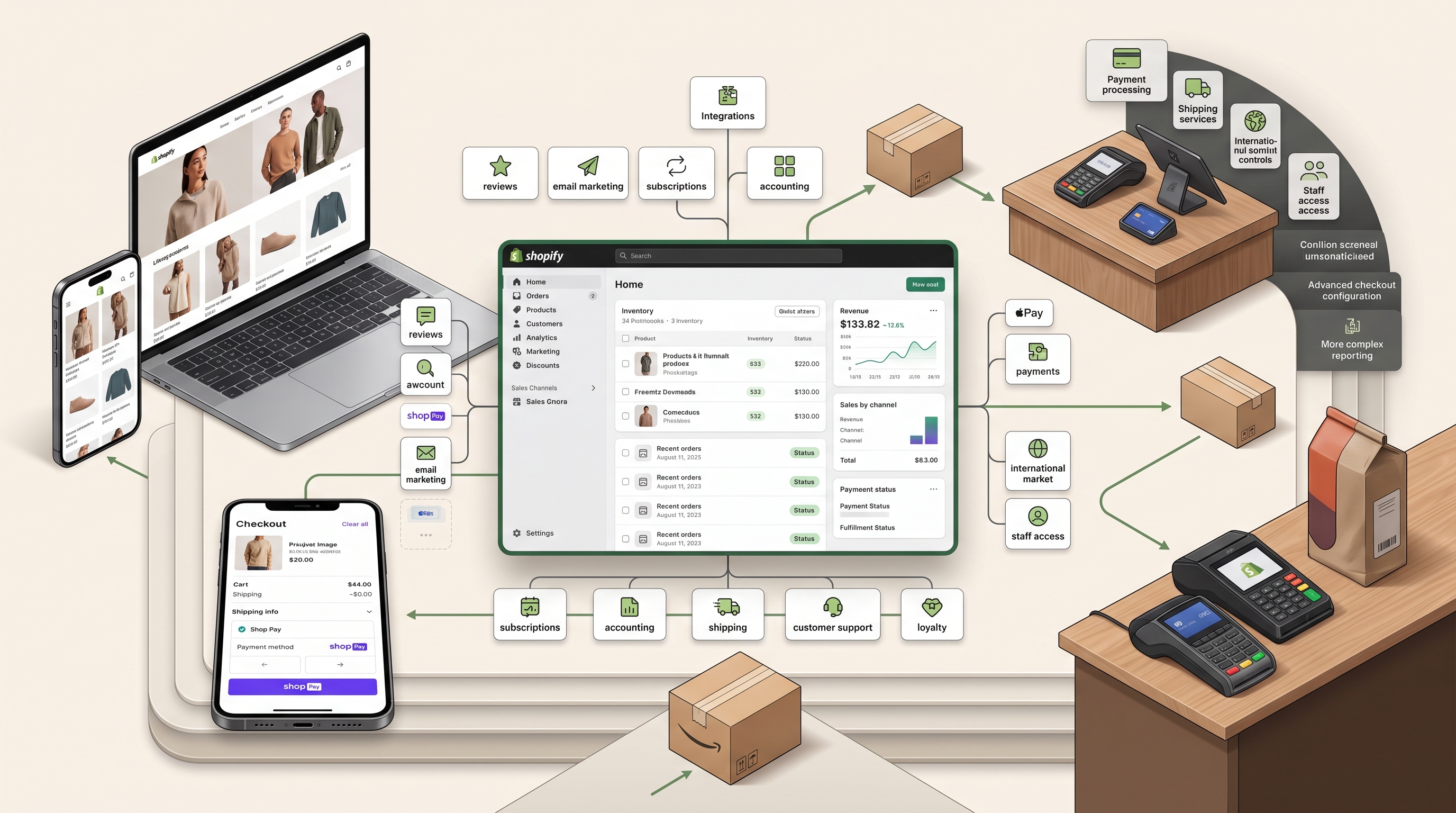
Shopify is a hosted commerce platform for building an online store, taking payments, managing products and orders, selling through multiple channels, and extending the store with apps and APIs. It is one of the easiest ways to get a serious store online, but it is not a low-cost website builder once subscription fees, payment processing, apps, themes, and operational work are included. This research-based Shopify review explains who should choose it, what the plans really cost, and where the platform becomes a poor fit.

Product profile
Shopify
See Shopify’s BettrList score, saved plan summary, product facts, and official link.
BettrList may earn a commission from some outbound product links. This does not affect Shopify’s score, recommendation, pros, cons, or alternatives in this review.
Shopify review: quick verdict
Shopify is recommended with caveats. It is a strong fit for a solo seller, a small retail team, or a growing brand that wants hosted commerce, a dependable checkout, sales channels, payment tools, and a large app ecosystem in one system. Basic is enough for a one-owner store. Grow is the practical small-team plan. Advanced can make sense for international or higher-volume operations, but its price needs a real business case. Shopify is not universal because monthly costs rise quickly, apps can become essential, third-party payment fees can apply, and the most advanced checkout controls are reserved for Plus.
- Best reason to choose Shopify: a hosted commerce foundation that covers products, checkout, orders, payments, channels, and extensions.
- Main weakness: the subscription is only part of the cost. Payment processing, apps, themes, services, taxes, and implementation can change the total.
- Best starting point: Basic for one owner, Grow for a small team, and Advanced only when its market, shipping, staff, or rate advantages pay for themselves.
- What to check first: annual versus monthly billing, payment availability in your market, app dependencies, staff access, shipping needs, and privacy responsibilities.
What is Shopify?
Shopify combines an online storefront, product catalog, checkout, order management, payment options, customer records, analytics, and sales channels. Merchants can use themes and the online store editor, sell through social and marketplace channels, add physical sales through Shopify POS, and install apps for marketing, shipping, subscriptions, reviews, accounting, and other workflows. Developers can extend the platform through APIs, Shopify Functions, theme code, and checkout or admin extensions.
The hosted model is the core appeal. Shopify operates the commerce infrastructure, so the merchant does not need to maintain a server, database, payment gateway stack, or checkout deployment. The trade-off is platform dependence. You still own your business and content, but the store’s workflows, integrations, and checkout behavior are shaped by Shopify’s plans, APIs, app rules, and product changes.
Who is Shopify designed for?
Shopify is designed for businesses where selling products is a central activity. A solo creator can launch a focused catalog. A small retailer can combine online and in-person sales. A brand can add email, social, marketplace, international, and fulfillment workflows as it grows. An agency or developer can build custom apps, headless storefronts, or operational integrations when the standard admin is not enough.
It is less suitable for a content-first site that only takes occasional payments, a business that needs full control of its server and database, or a team that wants all advanced features in the lowest plan. It can also be a poor fit for a regulated organization that needs exact contractual, regional, retention, or data-processing controls without a formal review.
Shopify features that matter in practice
Storefront, themes, and checkout
Shopify gives you a hosted storefront with themes, templates, product pages, cart, checkout, customer accounts, and built-in commerce administration. This matters because a new seller can focus on products, pricing, shipping, and marketing rather than deploying a web stack. The limitation is that the most important buyer journey is still a platform surface. Deep checkout customization is not available in the same way on every plan, and some custom experiences require Plus or approved extensions.
Products, orders, inventory, and channels
Shopify’s published help material lists unlimited products and bandwidth across the main plans, along with analytics, discount codes, abandoned-checkout recovery, manual order creation, sales channels, and POS. These are more useful than a long feature checklist because they connect the storefront to daily operations. The real value appears when products, stock, orders, and customer activity need to stay consistent across more than one selling channel.
Apps, APIs, and custom integrations
The app ecosystem is one of Shopify’s biggest advantages. If the core admin lacks a workflow, an app or custom integration may fill the gap. Shopify’s APIs support reading and writing store data, while Functions can handle selected discount, payment, delivery, and validation logic. Developers must still manage authentication, access scopes, rate limits, version changes, app costs, and data permissions. This flexibility is powerful, but it also creates an ecosystem that needs governance.
Payments and transaction economics
Shopify Payments can reduce payment setup work and provides built-in fraud analysis when used. Shopify says there are no monthly, hidden, or setup fees for Shopify Payments beyond the card rate and subscription, but the actual card rate varies by plan and market. If you use a third-party provider, Shopify says subscription transaction fees can apply in addition to the provider’s own fees. This is a key buying factor. A plan that looks affordable at low volume can have a different total cost once sales and payment routing are included.
How Shopify works in practice
A sensible setup starts with the catalog and business rules, not the theme. Add products, variants, prices, inventory locations, shipping, taxes, payment providers, policies, and customer notifications. Then choose a theme, configure navigation, connect the necessary channels, and test checkout with realistic orders. This sequence helps because the store’s product and fulfillment model usually creates more risk than the visual design.
The next decision is which apps are truly needed. Reviews, subscriptions, bundles, email, shipping, accounting, and support can all be useful, but every app adds a permission surface, a possible monthly charge, and another dependency. Keep the initial stack small. Add an app when a real workflow needs it, and record what data it can read, what it changes, and how you would remove it later.
Ease of use and setup
Shopify is easier to launch than a self-hosted commerce system because the hosting, checkout, updates, and much of the payment infrastructure are managed for you. The admin is broad but coherent, and Shopify publishes a large Help Center, community resources, training, and partner network. The main usability risk is not the first store. It is the number of decisions that appear after launch: shipping exceptions, discounts, markets, taxes, app conflicts, customer privacy, fulfillment, and reporting.
Shopify pricing and plans
The prices below are US prices checked on August 16, 2026. Shopify shows lower effective monthly prices for annual billing and higher prices for monthly billing. The subscription is not the full cost of running a store. Add payment processing, possible third-party transaction fees, apps, themes, taxes, hardware, shipping services, and professional help where needed.
Shopify plans checked August 16, 2026| Plan | Annual price | Monthly price | Useful distinction |
| Basic | $29/mo | $39/mo | Solo store and one-owner operation |
| Grow | $79/mo | $105/mo | Small teams and up to 5 staff accounts |
| Advanced | $299/mo | $399/mo | Up to 15 staff, live third-party shipping rates, regional controls |
| Plus | Not shown as annual | From $2,300/mo | Complex businesses, enterprise controls, and custom scope |
Basic is the sensible starting point for a solo store. Grow is easier to justify when several people need operational access or when the lower published card rates can materially affect the business. Advanced is a capability plan for international, shipping, staff, or higher-volume needs. Plus is a sales-led decision for complex businesses that need enterprise features, custom checkout work, B2B capability, or a different support and onboarding model.
Free trial and important upgrade triggers
Shopify offers a trial, but the length and promotional price can vary based on when and how the account is created. The pricing page checked for this review showed three days free followed by $1 per month for three months. Shopify’s help documentation says the initial store can have a password or inactive checkout, and a paid plan is needed to let customers purchase normally. Treat the promotion as a way to validate setup, not as a long-term cost estimate.
- Move from Basic when staff access, reporting, lower processing rates, or a specific workflow is worth the added subscription.
- Move from Grow when you need more staff, live third-party shipping rates, or regional market controls and the margin supports Advanced.
- Consider Plus when checkout customization, B2B, staff scale, enterprise support, or complex governance cannot be handled on Advanced.
- Review app costs whenever an app becomes part of a core workflow. An app can be more expensive than the plan change that first attracted you.
Security, privacy, and compliance
Shopify publishes Level 1 PCI DSS compliance information and says it has SOC 2 Type II and SOC 3 reports for the service it provides. That is useful for a merchant that does not want to build payment infrastructure and baseline hosting controls from scratch. Shopify also publishes privacy tools and guidance for GDPR and other data-protection obligations.
The important limitation is responsibility. Shopify states that merchants remain responsible for their store, products, transactions, regulatory compliance, and the markets they serve. A store owner still needs to configure privacy choices, write accurate policies, review apps and subprocessors, understand international transfers, manage access, and seek legal advice where needed. Platform security is not the same as automatic compliance.
Support and documentation
Shopify publishes 24/7 support for its plans and provides Help Center articles, community discussion, training, status information, and a global partner ecosystem. That is a strong support surface for common setup questions. It does not remove the need for specialist help. A merchant may still need an accountant for tax setup, a developer for a custom integration, or a privacy professional for a complex data flow. Support can explain the platform without owning the business decision.
Shopify pros and cons
Main strengths
- Hosted storefront and checkout reduce infrastructure work for a new merchant.
- The commerce admin connects products, orders, payments, analytics, channels, and POS.
- The app and API ecosystem gives a store room to grow into custom workflows.
- The published plan structure gives a clear path from solo operation to enterprise scope.
Main weaknesses
- The subscription is only one part of the cost. Payment fees, apps, themes, taxes, and services can raise the total.
- Monthly billing costs more than the annual effective rate, while annual billing increases the upfront commitment.
- Staff access, market tools, shipping features, and checkout customization are divided across plans.
- The platform makes a store easier to launch but creates dependence on Shopify’s product rules, APIs, app ecosystem, and pricing.
Shopify alternatives
Compare Shopify with WooCommerce if owning more of the stack and using WordPress are priorities. Consider BigCommerce when your catalog, B2B model, or commerce operations need a different enterprise path. Wix can be a better fit for a site-first business with a smaller store. A custom or headless stack can offer more control, but it also brings hosting, development, security, and maintenance work that Shopify deliberately removes.
Who should choose Shopify?
Shopify is easiest to recommend when the buyer values speed to launch, reliable hosted checkout, connected commerce operations, and the ability to add tools later. It is harder to recommend when the store is small enough that a full commerce subscription feels heavy, when the team needs complete infrastructure control, or when regulatory and data requirements need a contract and architecture review before the platform can be approved.
Final verdict
Choose Shopify if your business is becoming a real product-selling operation and you want a managed foundation for the storefront, checkout, orders, payments, channels, and integrations. Start with the lowest plan that supports the actual workflow, not the plan that promises the most features. Before paying, model annual versus monthly billing, payment fees, app costs, taxes, staff access, shipping, and the cost of professional help. Shopify is a capable default for many merchants, but the best decision depends on whether its convenience and ecosystem outweigh the ongoing cost and platform dependence in your situation.