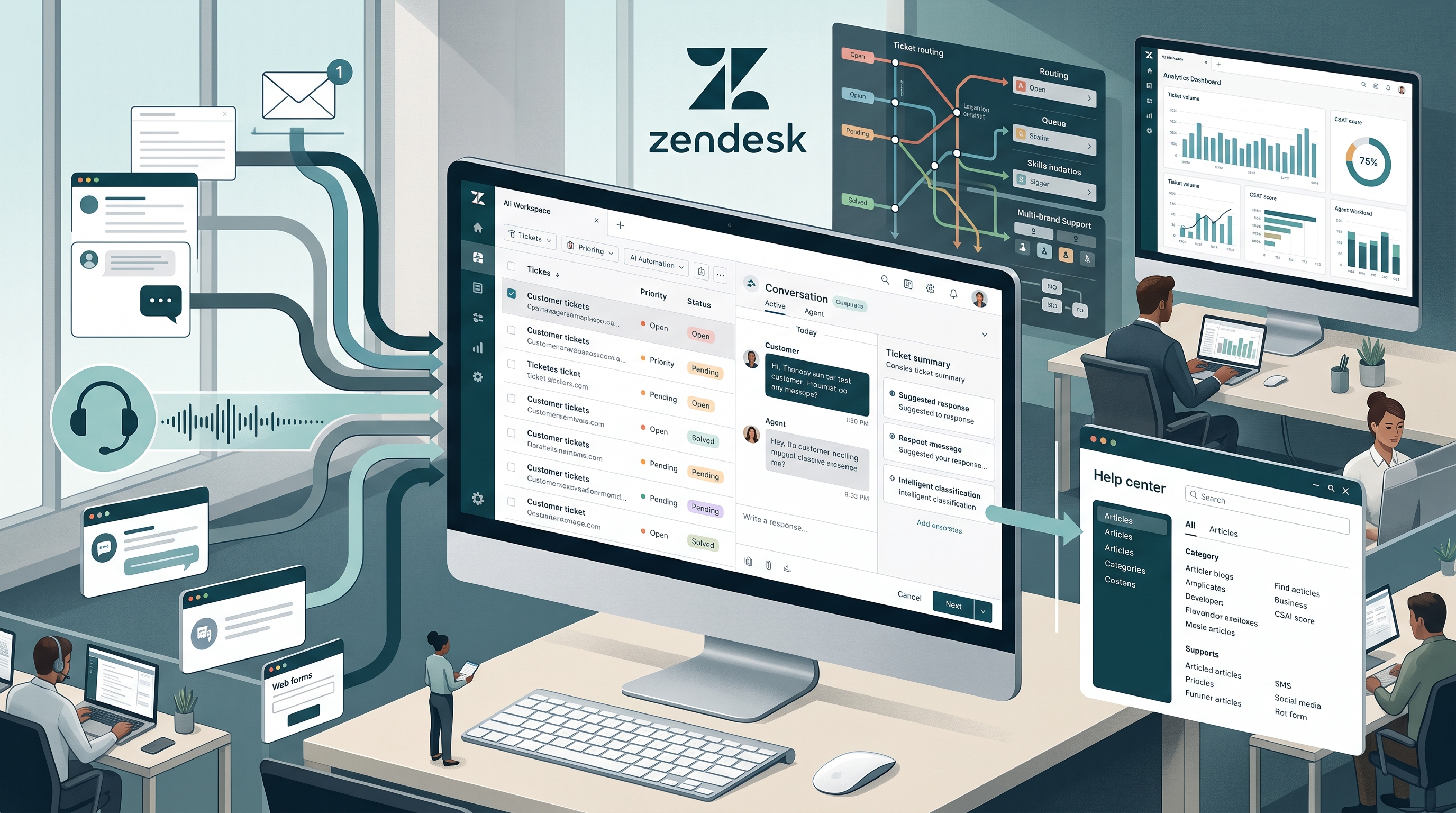
Zendesk is a serious customer-support platform for companies that have moved beyond a shared inbox. It combines ticketing, messaging, chat, voice, help-center content, routing, reporting, automation, and AI in one system. That breadth is useful when support is a real operation with several channels and clear service targets. It is harder to justify when one person only needs to answer a small email queue.

Product profile
Zendesk
See Zendesk’s existing BettrList profile for its reusable score, plans, platforms, and product facts.
Research basis: this review uses Zendesk’s public pricing, product, help, developer, security, privacy, and legal documentation checked on the date shown above. It does not claim first-hand use of a Zendesk account.
Zendesk review: quick verdict
Zendesk is recommended with caveats. Choose it when your support team needs a unified workspace for several channels, structured routing, help-center self-service, reporting, and a credible compliance program. Avoid it when your support volume is small, your workflow is simple, or your budget cannot absorb per-agent pricing and usage-based extras. The right next step is to run one real workflow through the 14-day trial, export anything important before the trial ends, and compare the total cost against a simpler help desk.
- Best reason to choose Zendesk: it gives a growing support operation one place for tickets, channels, knowledge, routing, and reporting.
- Main weakness: the headline seat price does not show the full cost of AI resolutions, add-ons, voice usage, storage, or higher-plan controls.
- Best starting point: Support Team for ticketing only, or Suite Team when chat, messaging, voice, and a help center are part of the real workflow.
- Review method: research-based. This article does not claim hands-on testing, screenshots, benchmarks, or workflow results.
What is Zendesk?
Zendesk is a cloud customer-service platform built around tickets and customer conversations. A request can enter through email, web forms, messaging, chat, social channels, or voice. Agents work in a shared workspace with customer context, internal notes, routing rules, automations, and reporting. A help center lets customers search articles before opening a ticket, while AI agents can handle selected questions and actions without a human response.
Zendesk is closer to an operating system for support than to a simple inbox. It can replace several tools, but that only pays off when the team uses the operational features. Low-volume, single-channel support may gain more work than value.
Who is Zendesk designed for?
Zendesk is designed for support teams that need consistent handling across agents, brands, channels, or regions. A SaaS company can route technical questions to specialists and publish a searchable knowledge base. An agency can separate clients or brands, track response targets, and give managers service reports. A regulated company can use the Trust Center, data-processing terms, access controls, redaction, and data-locality options as part of a wider compliance review.
It is less suited to a freelancer with occasional questions, a small business that only needs shared email, or a team without an owner for routing, permissions, macros, and help-center content. Its strongest value appears when support itself needs structure.
Zendesk features that matter in practice
Ticketing, routing, and automations
The core ticketing system turns incoming requests into trackable work. Agents can use customer context, internal notes, prewritten responses, triggers, and automations. The current pricing page also lists ticket routing and prebuilt analytics dashboards from the Support Team entry plan. This matters because a support team can define ownership and escalation rules instead of relying on memory. The limitation is administrative. Good results depend on clean ticket fields, sensible categories, useful macros, and rules that do not conflict with one another.
Omnichannel support and voice
Suite plans add messaging, live chat, voice, social channels, and a unified agent workspace. The plan documentation describes email, voice, SMS, live chat, web, mobile, and social support across the Suite. This is valuable when customers expect to switch channels without losing history. It is less important if nearly every request arrives by email. Voice also has its own usage and plan considerations, so a team should price phone numbers, minutes, routing, recording, and any contact-center needs separately.
Help center and self-service
Zendesk Guide gives teams a customer-facing knowledge base. Customers can search articles, and agents can use the same content while replying. The public plan documentation shows that help-center depth, article management, multiple help centers, permissions, and theme controls vary by plan. This feature can lower repetitive questions and make support more consistent. It creates a maintenance obligation too. Articles need owners, review dates, clear permissions, and a process for removing outdated instructions.
AI agents and Copilot
Zendesk’s current AI model has two parts. AI agents can interact with customers on messaging, email, web forms, and some voice workflows. Their usage is measured by automated resolutions, meaning a customer request that the AI resolves without escalation. The official help documentation lists included allowances by plan and says teams can buy more if needed. In May 2026 Zendesk removed the old Essential versus Advanced distinction for the current packaging, so older plan descriptions should not be used as the only pricing reference.
Copilot helps agents with writing, ticket summaries, and intelligent triage. Eligible Suite and Support Professional plans include a pooled allowance of five writing or summary uses per agent per month, subject to a 500-use monthly cap. The Copilot add-on provides unlimited use at the public annual price of $50 per agent/month. AI is useful when agents handle repetitive or long tickets. It is not free automation. Usage limits, review work, model errors, data policy, and the cost of successful automated resolutions all matter.
Reporting, SLAs, and operations
Zendesk includes prebuilt reporting and analytics dashboards, while higher plans add custom reports, SLA management, skills-based routing, and more operational controls. These features matter when a manager needs to understand response times, resolution rates, volume, customer satisfaction, or queue health. The trade-off is that reporting quality depends on the ticket model. If agents skip fields or teams define categories differently, the dashboard can look precise while describing inconsistent work.
How Zendesk works in practice
Based on the published workflow, a typical Zendesk setup starts by connecting support channels, defining ticket fields, writing response templates, and assigning groups or skills. Incoming requests become tickets or conversations. Routing sends them to an appropriate team. Automations can escalate unattended work, while the help center handles common questions before they reach an agent. Managers then use dashboards and service targets to find slow queues or recurring problems. AI can suggest a reply, summarize a conversation, classify the request, or resolve a supported question.
The connected design is powerful but demanding. Assign ownership for fields, routing, macros, knowledge, AI instructions, and reports. Start with one queue and add automation only when each rule has a clear owner.
Ease of use and setup
Zendesk has enough prebuilt structure to avoid starting from a blank database. The unified workspace, standard ticketing, prebuilt dashboards, and plan-specific tools help a team get a basic queue running. The harder work appears after launch. Teams must decide how to classify requests, who owns each queue, which agents can see sensitive tickets, how articles are approved, and which reports are trusted. That makes Zendesk easier for a support manager with a clear process than for a small business that wants software to design the process for them.
Zendesk pricing and plans
The prices below are US list prices checked on the date shown above. Zendesk charges mainly per agent seat. Annual prices are shown as a monthly equivalent and require an annual subscription. Monthly billing costs more. Enterprise plans are sales-assisted. AI automated resolutions, voice, App Builder, Action Builder, extra storage, data locality, Copilot, Workforce Engagement, and Contact Center can add usage or seat costs.
Zendesk plans checked 2026-08-23| Plan | Annual price | Monthly price | Best use and important limits |
| Support Team | $19 per agent/month, billed annually | $25 per agent/month | Ticketing, routing, dashboards, automations, and a help center. No full Suite omnichannel bundle. |
| Suite Team | $55 per agent/month, billed annually | $69 per agent/month | Entry Suite for messaging, live chat, voice, help center, AI agents, and omnichannel routing. |
| Suite Growth | $89 per agent/month, billed annually | $115 per agent/month | Higher-volume operations with more help-center capacity, routing, light agents, and self-service tools. |
| Suite Professional | $115 per agent/month, billed annually | $149 per agent/month | Skills-based routing, SLAs, custom reports, richer AI assistance, and stronger operational controls. |
| Suite Enterprise | Custom | Custom | Custom roles, sandboxes, approval workflows, governance, and sales-assisted terms. |
Free plan and free trial
Zendesk does not publish a permanent free plan for the current Support and Suite products. It offers a 14-day free trial with no credit card required. The default trial is based on Suite Professional and includes access to premium support workflows, AI, reporting, and integrations for evaluation. Zendesk’s trial terms say service data and configurations can be permanently lost when the trial ends unless the customer purchases the service or exports the data first. Treat export as part of the trial checklist, not as an afterthought.
Important limits and upgrade triggers
- AI agents use automated resolutions. The published help documentation lists five per agent/month for Suite Team, ten for Growth and Professional, and fifteen for Enterprise, with a maximum of 10,000 allocated resolutions per year. Extra usage can create overage charges.
- Copilot’s included writing and summary allowance is five uses per agent/month, pooled across the account and capped at 500 uses. The features pause after the allowance is reached unless the team waits for the next cycle or buys the Copilot add-on.
- Storage is plan-based. Team starts with 10 GB of ticket data, 10 GB of file storage, and 100 MB of external content per account, plus smaller per-agent allocations. Growth and Professional provide higher external-content and per-agent file allocations, but storage is still a limit to monitor for attachment-heavy support.
- Voice, App Builder, Action Builder, extra storage, data locality, high-volume API, sandboxes, WhatsApp numbers, and Workforce Engagement can be separate add-ons or usage charges. The base seat price is not a complete budget.
- Enterprise controls are a real upgrade trigger. Custom roles, sandbox environments, approval workflows, audit needs, advanced retention, procurement, and negotiated data terms may require a sales-assisted plan or add-on.
Integrations and compatibility
Zendesk has a broad integration surface. Its API reference covers ticketing, users, organizations, help center content, AI agents, messaging, voice, omnichannel features, custom data, mobile SDKs, and apps. The Marketplace lists public apps, integration apps, bots, and help-center themes. Zendesk Integration Services can respond to events, call Zendesk or external APIs, and run private workflows without requiring a separate middleware service for every use case.
The existing BettrList Product record lists Web, iOS, Android, and API support. That fits teams working in a browser, checking queues on mobile, or connecting Zendesk to a CRM, commerce system, identity provider, or internal database. The main limitation is the design work for permissions, authentication, ownership, rate limits, and failure handling.
Security, privacy, and compliance
Zendesk publishes a mature security and compliance program. Its Trust Center lists SOC 2 Type II, ISO 27001:2022, ISO 27018, ISO 27701, ISO 27017, ISO 42001, and FedRAMP LI-SaaS information. It also documents two-factor authentication, IP restrictions, audit logs, redaction, encryption options, data deletion, data locality, and a Data Processing Agreement. Zendesk says the subscriber controls Service Data and Zendesk acts as a processor for that data in the service relationship.
The important caveat is plan and configuration. Zendesk says HIPAA-enabled use requires the appropriate advanced security or compliance add-on, enabled controls, and a Business Associate Agreement. Data-center selection can require a data-locality service or plan functionality. A certification is useful evidence, but a regulated buyer still needs to confirm the exact products, region, retention rules, subprocessors, AI settings, and customer-side access controls.
Support and documentation
Zendesk’s public documentation is a strength. The Help Center covers plans, ticketing, knowledge, AI, billing, storage, security, and administration. Developers get API, Marketplace, and Integration Services material. The support experience still depends on the plan and purchase path, so buyers needing onboarding or priority response should confirm those terms.
Zendesk pros and cons
- Pros: Broad ticketing, chat, messaging, voice, knowledge, routing, reporting, and AI coverage in one platform.
- Pros: Strong public documentation for admins, developers, integrations, security, and compliance reviews.
- Pros: Clear upgrade path from ticketing-only Support Team to Suite plans and enterprise controls.
- Pros: Published compliance, redaction, data-locality, and access-control material is useful for formal procurement.
- Cons: Per-agent pricing becomes expensive as more people need seats or as the team adds multiple channels.
- Cons: AI agents, Copilot, voice, storage, and add-ons introduce usage limits and budget complexity beyond the base seat price.
- Cons: Strong results require ongoing administration for fields, routing, macros, knowledge, permissions, and reports.
- Cons: A simple email queue can be cheaper and easier to maintain in a smaller help desk or shared inbox.
Zendesk alternatives
Intercom is the more natural alternative when proactive messaging, in-product conversations, and customer engagement matter as much as ticket workflow. Freshdesk is worth comparing when you want a conventional help desk with a lower starting cost and less enterprise depth. Gorgias is more focused for ecommerce support tied closely to orders and store context. A lightweight shared inbox may be the best alternative for a solo operator or small team with low ticket volume. The choice depends on whether the main problem is omnichannel operations, proactive messaging, ecommerce context, or simple assignment.
Best use cases and poor-fit use cases
Zendesk is a strong fit for a SaaS company with separate technical and account queues, a growing agency managing support for several brands, a consumer business that needs email, chat, social, and voice in one workspace, and a regulated organization that needs documented security controls. It is also useful for teams that want to connect support tickets to a CRM, commerce system, product database, or internal workflow.
Zendesk is a poor fit for occasional support handled by one person, a team that does not want to maintain a help center or routing model, or a buyer that cannot forecast seat and usage costs. It is also a poor fit when the organization needs a custom compliance condition that Zendesk’s selected plan, region, add-ons, or contract cannot satisfy. In those cases, more features do not solve the buying problem.
Decision scenarios
The most useful Zendesk decision is not whether the product has enough features. It is whether your support process is complex enough to benefit from them. The scenarios above show why the same platform can be a good fit for one team and unnecessary for another.
- If you need only ticketing, price Support Team against a simpler help desk before selecting Suite.
- If you need chat, messaging, voice, and a help center together, start the comparison at Suite Team rather than trying to assemble the channels as add-ons.
- If you need skills-based routing, SLA management, or custom reporting, model Suite Growth and Professional with real agent counts and usage.
- If you handle sensitive data, include the security review, data locality, BAA or DPA, AI settings, and retention requirements before importing data.
- If you expect AI to reduce support cost, measure the number of successful automated resolutions and include overages, Copilot, review time, and escalation quality in the calculation.
Final verdict: is Zendesk worth it?
Zendesk is worth it when customer support is becoming an operational function rather than a shared mailbox. It gives teams a capable base for ticketing, channels, knowledge, routing, reporting, integrations, and AI. Its compliance and developer documentation also make it easier to evaluate for serious procurement. The trade-off is cost and administration. Start with the smallest plan that supports the actual workflow, use the trial to test routing and reporting, export data before the trial ends, and ask for a full quote that separates seats, AI resolutions, add-ons, voice, and governance. For simple support, choose a smaller tool. For complex support, Zendesk is a defensible choice with caveats.